
 ES
 RU
 TR
 FA
 AR
 ZH
Blog
Blog description

INTERPOL CCF Revision Rejected: What Legal Options Remain?
After the Commission for the Control of INTERPOL’s Files (CCF) rejects an application for revision, there is no ordinary appeal to a higher INTERPOL body. Further options depend on the rejection’s reasons, qualifying new facts, possible action by the authorities supplying the data, national proceedings, and the immunity rules governing any lawsuit against INTERPOL.
The distinction matters for individuals, their lawyers, and businesses assessing the consequences of international police information. An unsuccessful CCF application may leave questions about a warrant, detention, extradition, or inaccurate national records unresolved. The first step is to identify the decision that needs to change and the authority legally capable of changing it.
What a rejected CCF revision means
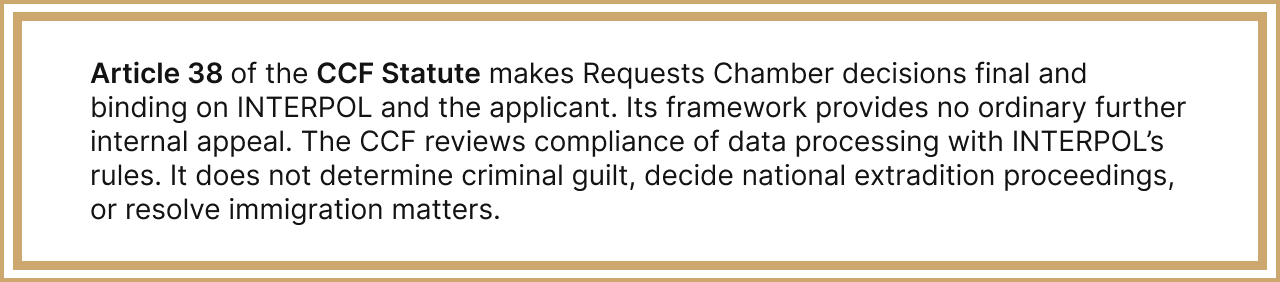
Losing before the CCF therefore does not decide every legal question affecting the person.
The compliance inquiry concerns whether particular information satisfies the rules governing its processing. Relevant issues may include accuracy, lawful purpose, proportionality, fundamental rights, and INTERPOL’s neutrality requirements. A submission should identify the applicable rule and the specific defect alleged, then explain how the evidence bears on that defect. General criticism of a prosecution does not, by itself, explain why the particular INTERPOL data should be changed.
Counsel should first establish what the revision refusal actually decided. Was the submission incomplete? Did it fail the requirements for revision? Or did the CCF accept the new material for review and nevertheless find the data compliant? Those outcomes call for different assessments.
The CCF provides written, reasoned decisions, but access to underlying information can be restricted under its rules. A review of the reasons should distinguish the findings actually communicated from assumptions about undisclosed evidence.
A useful working comparison links each decisive finding to the evidence previously considered, the new material now available, and the change requested. Where the basis for a finding is unclear, the submission should identify that uncertainty expressly. This helps prevent an application from answering a question different from the one that determined the earlier result.
The two stages of revision review
Revision involves a preliminary question about qualifying facts and a separate question about the result those facts justify. The CCF’s published Decision No. 2023-09 illustrates the difference. The applicant supplied judicial judgments not known when the Commission decided the original deletion request. They were presented within the discovery period and potentially capable of affecting the conclusion. The Commission found that the revision criteria were satisfied and proceeded to examine compliance.
After assessing the expanded record and consulting the source authorities, however, the CCF concluded that the challenged data remained compliant. Acceptance for revision did not produce deletion. The decision is a historical illustration of the two stages; it does not establish an entitlement to successive revision applications.
This distinction should guide the next review of the file. If the revision requirements were not met, the record must address that specific failure. If the CCF reconsidered compliance and refused deletion, counsel must examine the substantive findings rather than assume that proving newness alone will change the outcome.
Chart 1 What the rejection actually decided
|
Finding in the refusal |
What to examine |
Possible next assessment |
|---|---|---|
|
Procedural defect |
Letter and required documents |
Whether correction is permitted |
|
Facts already considered |
Earlier submissions and new material |
Whether there is a different factual basis |
|
Insufficient materiality |
Connection to decisive findings |
Which finding the new evidence could change |
|
Discovery deadline not met |
Chronology and dated records |
Whether the discovery date was correctly established |
|
Data still compliant after revision |
Substantive findings and expanded record |
Whether a separate factual or national remedy exists |
Analytical categories, not an official CCF classification. No row guarantees reopening or an extension of time.
When different new facts may justify further assessment

The CCF’s applicant guidelines identify recurring problems:
- facts were already known during the earlier examination,
- a new development is unlikely to affect the result,
- the submission is untimely, or
- it simply expresses disagreement.
A timing explanation should not be treated as guaranteeing an extension.
A practical submission should connect each development to a decisive finding. It should explain:
What happened
How the fact differs from what the CCF previously considered
Which document establishes it
Why that difference matters.
Acquittals, extradition refusals, and changes affecting warrants require an examination of their actual scope; their labels alone do not establish the requested outcome.
For example, a later judicial decision should be examined for the proceeding it concerns, the persons and conduct covered, its operative terms, and its procedural status. A summary or isolated passage may omit an important limitation. The analysis should make clear whether the decision changes a factual premise, affects the continuing basis for the information, or supplies a different legal argument about facts already considered.
Why the discovery date matters
The six-month period runs from discovery of the relevant fact. It does not automatically run from the revision rejection, and the rejection does not restart the period for the same facts.
A useful chronology distinguishes
- the date of an event,
- the date the person learned of it, and
- the date supporting records became available.
Notifications, correspondence, and document-access records can help explain that sequence. Obtaining a later translation or commissioning a new memorandum should not be assumed to create a fresh discovery date for a fact already known.
Where timing is disputed, the submission should address it directly. A document’s publication date may not fully explain when the relevant fact became known, while a recent cover letter may add nothing to the chronology.
Each proposed new fact should have its own discovery history. The date of the underlying development, first notification, receipt of a certified copy, and completion of a translation may differ. Counsel should explain those differences and preserve the supporting records, rather than assume that obtaining better documentation creates a new discovery period.
A published CCF decision provides a concrete illustration. In its 2019 Decision Excerpt No. 6, the Commission treated a later refusal by a foreign authority to cooperate in the underlying criminal matter as a new development and separately considered its significance for data compliance. The decision illustrates why the underlying event, its timing, and its connection to the earlier reasoning all matter.
What source authorities and the General Secretariat can do

This makes the current position of the authorities supplying the data an important part of the factual review. A request should identify the specific record, the change sought, and the official evidence supporting it. Counsel should establish whether a development affects every relevant proceeding or leaves another warrant, charge, or legal basis outstanding.
The objective should be stated precisely. Correcting a factual entry, updating procedural status, and withdrawing information are different requests. Describing them accurately helps the receiving authority understand the issue and allows the applicant to verify what action, if any, was taken.
Any response from the authority should also be checked against the original request. Confirmation that a domestic record was updated may not establish what changed in INTERPOL’s systems. Counsel should identify which authority acted, which record was affected, and the effective scope of the action. A request, acknowledgement of receipt, or promise to review the matter should not be mistaken for confirmation that the requested change occurred.
Chart 2 Potential routes after a rejected revision
|
Route |
Possible objective |
Principal limit |
|---|---|---|
|
Further Article 42 assessment |
Review based on different qualifying facts |
New material facts and discovery deadline; no automatic review |
|
Source authorities |
Correction or withdrawal of supplied data |
Authority and procedure vary; no guaranteed action |
|
General Secretariat |
Rule-based blocking, correction or deletion |
Separate compliance powers, not a higher appeal |
|
National proceedings |
Relief concerning national enforcement |
Forum, grounds and deadlines depend on applicable law |
|
Suit against INTERPOL |
Compensation or other available relief |
Jurisdiction, valid claim and immunity must be addressed |
A CCF refusal does not itself establish a right to any route. Headquarters-agreement arbitration excludes the relevant data disputes.
National courts may address separate enforcement consequences
Depending on applicable law, national proceedings may concern a warrant, arrest, detention, extradition, or domestic data handling. Each requires a competent forum and its own grounds and deadlines. An INTERPOL submission should not be assumed to preserve a national procedural deadline.
A Red Notice is a request to locate and provisionally arrest a person pending extradition, surrender, or similar legal action. It is not an international arrest warrant. Countries apply their own laws when deciding whether an arrest is authorized and what legal effect the notice has.
A specialized European example is the Court of Justice of the European Union’s judgment of May 12, 2021, in Case C-505/19, WS v. Bundesrepublik Deutschland. In the relevant EU and Schengen setting, a final judicial determination establishing the applicable protection against repeat proceedings for the same acts can preclude provisional arrest or continued custody based on the notice. The Court also addressed national remedies and domestic processing of the data.
That example concerns defined regional protections and national authorities. It is not an appeal against the CCF and does not establish automatic deletion from INTERPOL’s central systems. Its practical value is to show why the law governing a national enforcement measure deserves a separate assessment.
When a national court grants relief, its operative terms deserve particular attention. Counsel should examine the measure covered, territorial scope, duration, procedural status, and any further implementation required. This allows the judgment to be used accurately in related proceedings without attributing to it a broader effect than the court actually ordered.
Whether a court can hear a lawsuit against INTERPOL
A direct lawsuit requires an analysis of jurisdiction, a valid cause of action, applicable immunity, any exception or waiver, and the relief sought. The fact that the CCF rejected revision does not resolve those preliminary questions.
A litigation review should match the challenged conduct with the order sought and the proposed respondent. Release from national detention, correction of a local police record, withdrawal of a warrant, and deletion from INTERPOL’s systems involve different decisions. Identifying a court with authority over one measure does not establish its authority over every related issue. The analysis should state whose conduct is challenged and what legal obligation allegedly requires the requested relief.
In France, Article 5 of the headquarters agreement grants immunity from legal process subject to specified exceptions, including express contractual waiver, certain motor-vehicle claims, and connected counterclaims. The agreement also permits express waiver in particular cases. A disagreement about notice processing does not by itself establish that one of those exceptions applies.
In El Omari v. INTERPOL, 35 F.4th 83 (2d Cir. 2022), the U.S. Court of Appeals for the Second Circuit affirmed dismissal of claims arising from INTERPOL’s refusal to delete a Red Notice. The court found that INTERPOL enjoyed immunity and had not waived it for that suit.
El Omari is an important U.S. illustration, not a judgment establishing the outcome of every possible claim worldwide. A proposed compensation claim also needs a legal basis and evidence of the alleged wrong, causation, and recoverable loss. The immunity question must be addressed before treating litigation as a viable next step.
Enforcement is a further question. Even if a claim can proceed, counsel must examine how any resulting relief could be implemented. In France, Article 6 of the headquarters agreement separately protects INTERPOL’s property and assets against specified forms of administrative or judicial constraint, subject to listed exceptions. Jurisdiction, immunity from proceedings, and enforceability therefore require distinct analysis.
The CCF’s own remedial powers also deserve precision. Article 39 permits appropriate corrective action and, following a finding of noncompliance, other appropriate remedies limited to INTERPOL’s responsibilities and data processing in the particular case. This is broader than deletion alone. It does not create a further appeal after revision fails or establish an automatic entitlement to compensation.
Why headquarters agreement arbitration is restricted
The arbitration provisions of the France - INTERPOL framework do not supply a routine alternative after CCF rejection. The 2016 Additional Protocol excludes data-processing disputes falling within the CCF’s remit, including relevant disputes concerning notices, diffusions, and messages. Any reliance on the original agreement must account for this exclusion.
Three hypothetical examples
These examples illustrate issues for assessment and are not descriptions of clients or predictions of outcomes.
A warrant is withdrawn after rejection. An applicant obtains an official withdrawal decision concerning the warrant underlying the data. Counsel would examine the decision’s scope, the discovery chronology, and whether any other basis remains. Both source-authority action and a further revision assessment may warrant consideration; deletion should not be presented as automatic.
The documents should establish that the withdrawn warrant is the one underlying the challenged information. If the decision concerns only one count or one proceeding, that limitation should be identified. The next submission should explain the precise link between the withdrawal and the record to be corrected or deleted.
An acquittal concerns a different proceeding. A new judgment acquits the person in one case, while the challenged data concern separate allegations. The document may be authentic and recent yet fail to affect the CCF’s decisive findings. The submission must establish the connection between the judgment and the particular data under challenge.
The comparison should address the parties, alleged conduct, dates, and legal effect of the judgment. Two proceedings may share a person’s name or similar terminology yet concern different conduct. Explaining any overlap or distinction is more useful than relying on the word “acquittal” without the underlying reasoning.
One country refuses extradition. A court declines a particular extradition request after revision has failed. Counsel would examine the judgment’s grounds, territorial effect, and relationship to the retained data. A refusal based on one jurisdiction’s requirements should not be described as a worldwide resolution of arrest or extradition risk.
The grounds for refusing extradition may determine the judgment’s relevance to INTERPOL data compliance. Counsel should distinguish what the court actually found about the request from what it did not decide about the underlying allegations or continued international cooperation. Any further submission should accurately describe those limits and identify the finding that matters to INTERPOL data compliance.
Preparing a record for the next assessment
A consolidated record should include:
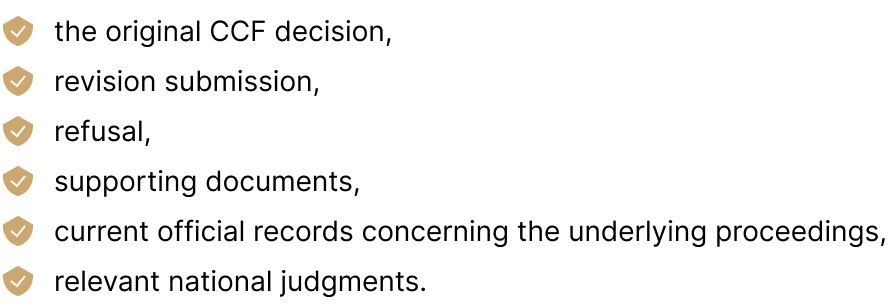
A separate chronology should track discovery dates and any national deadlines. Counsel can then distinguish a missing document from a missing legal basis.
The analysis should identify the authority responsible for each requested result and the evidence needed to support it. It should also distinguish verified official action from an applicant’s expectation or a third party’s description of a decision. Where urgent national proceedings are pending, those proceedings need their own coordinated response.
For each significant document, an evidence index can record:
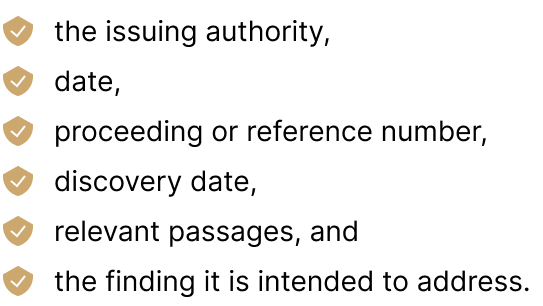
This is an organizational aid, not an additional statutory requirement. Its purpose is to make a complex record easier to verify and to expose gaps before a further application or national filing is prepared.
Further CCF applications generally must use the secure online portal, required since March 26, 2026. Alternative methods require exceptional circumstances recognized by the Commission. Individual CCF members should not be contacted directly.
The Commission generally works from written submissions. Its current general conditions require legible documents in an INTERPOL working language: Arabic, English, French, or Spanish. Preparing a concise explanation with clearly identified supporting records helps the Commission understand the request without assuming that an oral hearing will be available.
Frequently asked questions
Can a different lawyer file the same case again?
A change of representative does not itself provide newly discovered facts. The assessment concerns the factual basis and applicable revision requirements, rather than the identity of the lawyer.
Does the rejection create another six month period?
No. The period is tied to discovery of the relevant fact. A different later-discovered material fact requires its own assessment; reusing the same information does not restart the clock.
Does filing another application suspend the notice?
Filing alone should not be treated as suspension or protection from arrest. Article 37 permits discretionary provisional measures during proceedings, concerning INTERPOL data. National arrest and detention questions remain separate. CCF general conditions, section 6.
An urgent request should identify the precise data-related measure sought and provide documents explaining the urgency. The applicant guidelines identify detention and clearly imminent extradition among circumstances that may warrant urgent consideration, while noting that further checks may still be necessary. Article 37 operates during proceedings and should not be treated as a standalone appeal for reopening a closed case. Applicant guidelines, section 2.1.5.
Does losing before the CCF establish guilt or require extradition?
No. The Commission’s remit concerns INTERPOL data compliance. Criminal guilt and extradition are matters for the competent judicial or national authorities. CCF mandate.
Does a national court victory automatically remove INTERPOL data?
Its effect must be assessed. The ruling may resolve one national measure, provide important evidence, or affect the basis for retaining information. Its scope and implementation should be verified before treating the central data issue as resolved.
Can compensation be requested simply because revision failed?
An unsuccessful revision does not itself establish an actionable wrong or entitlement to damages. A claim requires a separate legal and evidentiary basis, and a claim against INTERPOL must address immunity and jurisdiction.
Conclusion
A rejected revision requires a precise assessment of what the CCF decided and what remains unresolved. Repackaging the same submission cannot substitute for identifying a qualifying factual development or a separate legal route.
The next strategy should connect the requested remedy to the authority capable of granting it. A reliable chronology, current official documents, and coordinated analysis of national proceedings provide the basis for deciding whether further action is supportable and what that action can realistically achieve.
A written strategy can then identify the objective, the authority to be approached, the supporting legal basis, the evidence still needed, and the relevant deadlines. That record gives the applicant and counsel a concrete basis for deciding which steps are justified, how parallel proceedings should be coordinated, and what would need to change before another route could become available.