
 ES
ES  RU
RU  TR
TR  FA
FA  AR
AR  ZH
ZH Blog
Blog description

How to Challenge Politically Motivated and Abusive INTERPOL Red Notices
An INTERPOL Red Notice can create serious consequences long before a court determines whether extradition is legally justified. A person may be detained while traveling, questioned at a border, subjected to immigration scrutiny, restricted by financial institutions, or forced to defend extradition proceedings in several countries.
These consequences become particularly concerning when a foreign government uses ordinary criminal charges: such as fraud, embezzlement, tax evasion, money laundering, extremism, or abuse of authority to pursue a political opponent, businessperson, journalist, former official, activist, or dissident living abroad.
Russia has received particular scrutiny concerning potentially politically motivated INTERPOL requests. Similar concerns have also been raised in connection with requests originating from China, Türkiye, Belarus, Azerbaijan, Kazakhstan, Tajikistan, Uzbekistan, Iran, Egypt, Bahrain, Rwanda, and other jurisdictions.
A request from one of these countries is not automatically invalid. INTERPOL does not maintain a public blacklist of abusive member countries, and every case must be examined individually.
Nevertheless, the requesting country’s record, the political and commercial context of the prosecution, the applicant’s status, and the conduct of the authorities may be highly relevant to a request for deletion before the Commission for the Control of INTERPOL’s Files, commonly known as the CCF.
What Is an INTERPOL Red Notice?
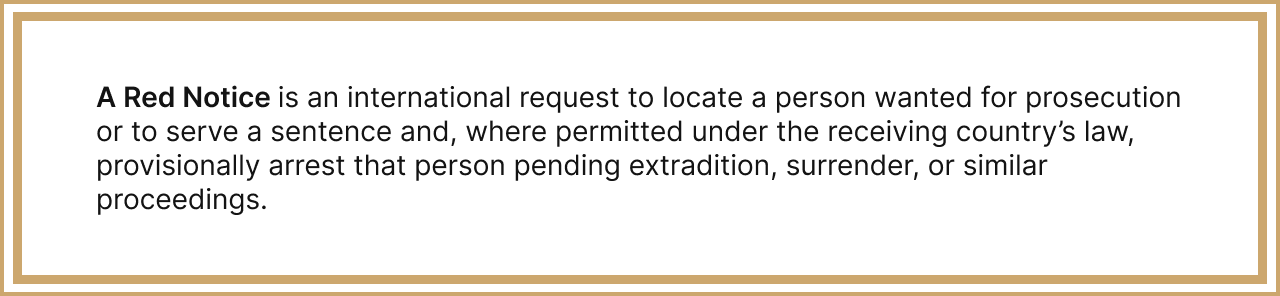
A Red Notice is not an international arrest warrant. INTERPOL does not itself arrest individuals, and each member country decides what legal effect to give a notice under its domestic law. Red Notices are published by the INTERPOL General Secretariat at the request of a member country’s National Central Bureau and must comply with INTERPOL’s Constitution and data-processing rules.
A member country may also circulate a wanted-person diffusion. A diffusion can create many of the same practical risks as a Red Notice, although it is distributed through a different process.
INTERPOL reviews incoming Red Notice and diffusion requests through its Notices and Diffusions Task Force. That review considers the underlying judicial information, the purpose of the request, the individual’s status, the geopolitical context, and compliance with Articles 2 and 3 of INTERPOL’s Constitution.
INTERPOL’s Political-Neutrality Requirement
Article 3 of INTERPOL’s Constitution states:

Article 2 separately requires INTERPOL to conduct its activities in the spirit of the Universal Declaration of Human Rights. INTERPOL identifies respect for human rights and political neutrality as central principles governing its activities.
A criminal prosecution does not become compliant merely because the requesting government describes the charge as an ordinary offense.
Where political and ordinary-crime elements coexist, INTERPOL applies a predominance analysis. Relevant factors include:
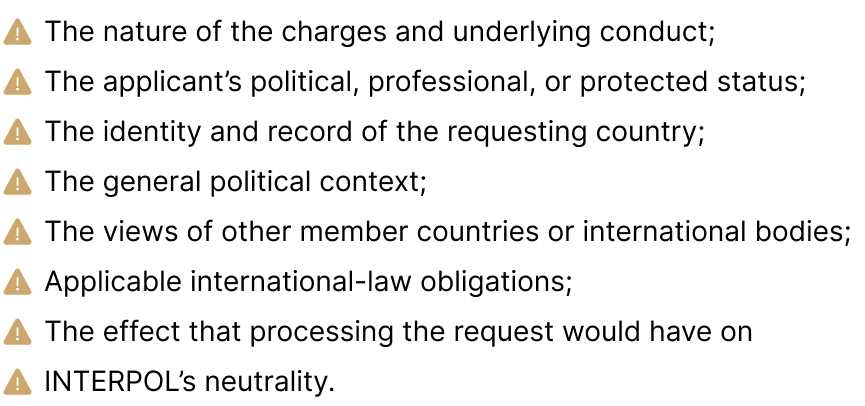
The CCF evaluates Article 3 arguments on a case-by-case basis and examines whether the political, military, religious, or racial elements predominate over the ordinary-law character of the alleged offense.
The U.S. TRAP Act and Abusive INTERPOL Requests
The United States has formally recognized the risk that authoritarian and other foreign governments may misuse INTERPOL mechanisms for political retaliation and other unlawful purposes. The (the TRAP Act) was enacted as part of the National Defense Authorization Act for Fiscal Year 2022 and is codified at 22 U.S.C. § 263b. The Act: establishes a U.S. policy of using the country’s voice, vote, and influence within INTERPOL
- to strengthen the screening of Red Notices, diffusions, and other communications;
- improve transparency;
- support the CCF; and
- address repeated attempts by member countries to circulate noncompliant information.
It also requires the Departments of Justice and State to assess and report on member-country abuse of INTERPOL systems for political motives and other unlawful purposes. Significantly, the Act provides that no U.S. government department or agency may extradite a person based solely on a Red Notice or diffusion issued by another INTERPOL member country.

Particularly where a request from Russia or another foreign jurisdiction may constitute transnational repression.
Russia and INTERPOL Red Notices
Russia is among the jurisdictions most frequently associated in institutional reporting with politically motivated prosecutions and the use of international legal mechanisms against persons living abroad.
The Parliamentary Assembly of the Council of Europe has expressly called on INTERPOL to exercise particular vigilance when reviewing potentially politically motivated Red Notice requests from the Russian National Central Bureau.
The concern is not limited to prosecutions openly labeled as political. Russian authorities may pursue a person through charges that appear facially ordinary, including:
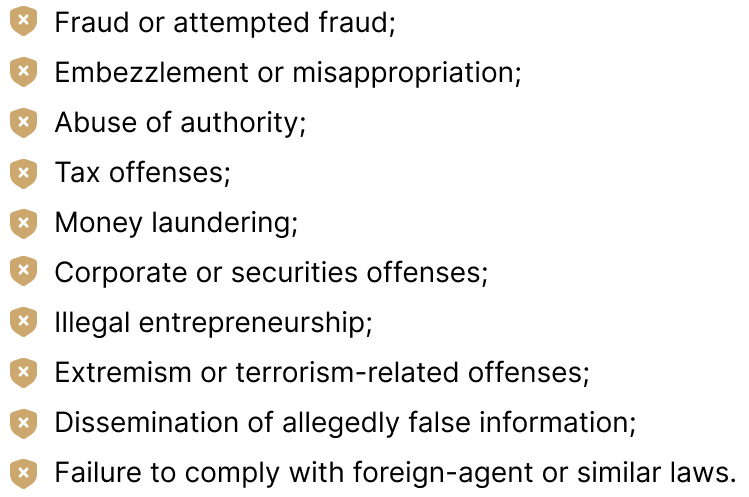
The legal analysis must therefore extend beyond the statutory name of the offense.
Political opposition and public criticism
A Russian request may require heightened scrutiny where the person:
- Supported an opposition party or movement;
- Criticized the Russian government or military;
- Participated in antiwar activity;
- Worked as an independent journalist;
- Represented politically disfavored clients;
- Supported civil-society or human-rights organizations;
- Was designated a foreign agent or extremist;
- Held office and later came into conflict with the authorities;
- Publicly accused officials of corruption;
- Refused to cooperate with state or security interests.
A temporal connection between protected activity and the opening of the criminal case may be especially important.
Commercial conflicts and state-connected interests
Russian INTERPOL matters may also arise from business disputes that contain a political, corrupt, or retaliatory dimension.
Warning signs may include:
- A dispute with a state-owned company;
- A conflict with a politically connected businessperson;
- A hostile corporate takeover or asset-seizure attempt;
- Competing claims to shares, real estate, intellectual property, or company funds;
- Criminal proceedings filed after unsuccessful civil litigation;
- Pressure to transfer or surrender business assets;
- Selective prosecution of one shareholder or executive;
- Allegations based primarily on the person’s corporate position;
- Charges initiated after the person left Russia;
- A complainant with close connections to prosecutors, security services, or regional officials.
A business relationship does not automatically make a prosecution illegitimate. Genuine fraud, theft, corruption, and money laundering may occur in a commercial setting.
The issue is whether the criminal allegations describe actual criminal intent and personal participation, or whether the criminal process is being used to resolve an ownership, payment, management, or contractual conflict.
Proceedings in absentia and procedural irregularities
Proceedings conducted in the person’s absence are not automatically incompatible with INTERPOL’s rules. However, an in absentia prosecution may become significant when combined with other irregularities, including:
- Lack of meaningful notice;
- Inability to obtain the charging documents;
- Denial of access to the case file;
- Destruction or unexplained disappearance of evidence;
- Reliance on testimony from interested parties;
- Failure to describe the applicant’s individual acts;
- Repeated rejection of defense evidence;
- Issuance of an arrest warrant immediately after departure;
- Lack of an effective opportunity to challenge the warrant;
- Inconsistent descriptions of the alleged offense.
The CCF does not act as an appellate criminal court. It will not ordinarily determine whether a Russian court correctly applied Russian criminal procedure.
Nevertheless, procedural defects can be relevant when they demonstrate that the data supplied to INTERPOL are inaccurate, incomplete, unsupported, politically influenced, or incompatible with fundamental human rights.
Sanctions against officials involved in the case
In some matters, judges, prosecutors, investigators, security officials, or complainants involved in the prosecution may have been sanctioned by the United States, European Union, United Kingdom, Canada, or another government.
A sanctions designation does not automatically invalidate the prosecution. Its relevance depends on the stated grounds for the designation and the official’s connection to the applicant’s case.
Where the designation concerns corruption, politically motivated prosecutions, serious human-rights violations, or abuse of judicial authority, it may provide corroborating evidence when combined with case-specific documentation.
Other Foreign Jurisdictions Requiring Careful Review
Russia is not the only country associated with concerns regarding transnational repression or potentially improper international police requests.
The Parliamentary Assembly of the Council of Europe has described misuse of INTERPOL notices and extradition mechanisms as one method through which governments enlist other countries to detain, deport, or otherwise act against persons abroad. It has identified China, Türkiye, Russia, Egypt, and Tajikistan among the most prolific perpetrators of transnational repression reported by Freedom House.
These findings do not establish that every request from those countries is abusive. They do establish that the requesting country’s practices may form part of the factual context considered in an individual case.
China
Concerns regarding Chinese requests have involved Uyghur activists, dissidents, religious minorities, former officials, anticorruption targets, and persons accused of economic crimes after leaving China.
A Chinese request may warrant careful review where the prosecution involves:
- Political or religious activity;
- Criticism of the Chinese Communist Party;
- Uyghur, Tibetan, Hong Kong, or other advocacy;
- A dispute involving a state-owned enterprise;
- A politically sensitive anticorruption investigation;
- Forced return efforts;
- Pressure against family members remaining in China;
- Confession evidence allegedly obtained through coercion.
Human-rights organizations have documented concerns that Chinese authorities have used INTERPOL mechanisms as part of broader transnational-repression campaigns.
Turkey
Reports concerning Turkey have involved journalists, writers, political opponents, alleged members of the Gülen movement, Kurdish activists, and other critics abroad.
The Parliamentary Assembly has stated that Turkish transnational-repression practices have included misuse of extradition proceedings, INTERPOL Red Notices, antiterrorism measures, and cooperation with other states to transfer targeted individuals.
Charges described as terrorism, membership in an unlawful organization, fraud, or financial misconduct may require examination of the applicant’s political activities and the broader context of the prosecution.
Belarus
Belarusian requests may raise concerns where tax, fraud, public-order, or economic charges follow opposition activity, independent journalism, participation in protests, or support for prodemocracy organizations.
Relevant evidence may include:
- The timing of the prosecution;
- Prior detention or threats;
- Public statements by officials;
- Pressure against family members;
- The applicant’s role in opposition or media activity;
- International findings regarding the same prosecution.
Azerbaijan, Kazakhstan, Tajikistan, and Uzbekistan
International reports have raised concerns regarding attempts by several former Soviet jurisdictions to pursue journalists, opposition figures, religious activists, former officials, and businesspeople abroad.
Cases from these jurisdictions may involve charges characterized as:
- Fraud;
- Embezzlement;
- Tax evasion;
- Extremism;
- Terrorism;
- Illegal religious activity;
- Abuse of office;
- Dissemination of false information.
The applicant should demonstrate how the ordinary criminal charge relates to political activity, a dispute with state-connected interests, or a broader pattern of retaliation.
Iran, Egypt, Bahrain, and Rwanda
Concerns involving these jurisdictions have frequently centered on dissidents, human-rights advocates, journalists, former officials, and opposition figures living outside their countries.
The legal significance of country-condition evidence depends on its connection to the applicant. General criticism of a requesting government is rarely enough.
The submission should identify the applicant’s activities, the government’s apparent motive, the procedural history, comparable cases, and any conduct directed against the applicant or the applicant’s family.
United Arab Emirates and financial disputes
Requests originating from the United Arab Emirates may present a different type of issue where criminal allegations arise from unpaid loans, dishonored checks, investment disputes, or failed commercial transactions.
The relevant question is whether the allegations establish genuine deception or misappropriation, or whether international police mechanisms are effectively being used to collect a private debt.
This issue is analytically distinct from political persecution, but it may still support deletion under INTERPOL’s rules governing private disputes, seriousness, proportionality, purpose, and the description of criminal conduct.
Legal Grounds for Challenging the Notice
A CCF application should identify every potentially applicable ground rather than relying on a generalized allegation of abuse.
Political character under Article 3
The application should explain why political elements predominate over the ordinary-law aspects of the case.
Evidence may include the applicant’s political activity, public statements by officials, selective prosecution, timing, comparable cases, and documented use of ordinary criminal charges against political opponents.
Human-rights concerns under Article 2
Article 2 arguments may involve:
- Risk of torture or mistreatment;
- Serious fair-trial deficiencies;
- Threats to life or personal safety;
- Retaliation for protected expression;
- Discriminatory prosecution;
- Risk of refoulement;
- Abuse of detention;
- Lack of an independent tribunal.
An extradition refusal based on human-rights grounds may be particularly important. INTERPOL expressly states that its review may consider the outcome of foreign extradition proceedings and the reasons another country refused extradition.
Refugee or asylum status
Refugee status granted because of persecution by the requesting country can be a significant factor.
The application should include the complete asylum or refugee determination where available, identify the protected grounds, and explain whether the criminal case is connected to the same alleged persecution.
A pending asylum application does not carry the same weight as a final grant, but the underlying evidence may remain relevant.
Inaccurate or incomplete information
The requesting country may have omitted or misstated:
- The applicant’s actual role;
- The existence of civil litigation;
- Payments or contractual performance;
- Dismissal of charges against codefendants;
- Favorable court rulings;
- Extradition refusals;
- Refugee determinations;
- Expiration or cancellation of the arrest warrant;
- Changes in the criminal proceedings;
- The complainant’s political or financial interests.
INTERPOL’s data-protection framework requires lawfulness, fairness, purpose limitation, accuracy, proportionality, and continuing relevance.
Insufficient description of personal criminal conduct
The notice should identify the applicant’s personal involvement in the alleged offense.
A conclusory assertion that the person was a director, shareholder, government official, or signatory may be insufficient if the requesting country does not describe what the person allegedly did, when it occurred, and how the conduct satisfies the offense.
Private, civil, or commercial dispute
Where the prosecution arises from a debt, contract, shareholder conflict, real-estate transaction, or investment loss, the application should distinguish ordinary nonperformance from fraudulent conduct.
Relevant evidence may include partial payments, delivery records, settlement negotiations, arbitration filings, civil judgments, and communications demonstrating an intention to perform.
Lack of continuing international purpose
The applicant should determine whether:
- The arrest warrant remains valid;
- The prosecution remains active;
- The requesting country has sought extradition;
- Extradition was previously refused;
- The sentence has been served or extinguished;
- Limitation periods have expired;
- The requesting country continues to cooperate with INTERPOL;
- The data remain necessary and proportionate.
A Red Notice should not remain in circulation indefinitely where it no longer serves a legitimate international-police purpose.
Evidence for a CCF Application
A well-supported application may include:
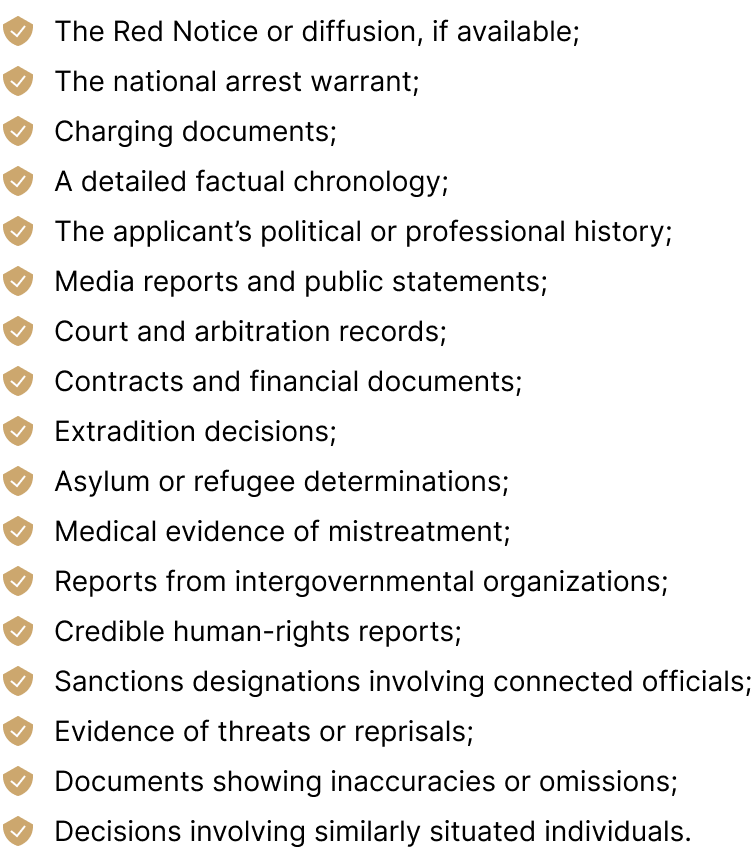
Country-condition evidence should corroborate the individual case rather than replace case-specific proof.
The most effective submission explains precisely how each document supports a particular INTERPOL rule or legal argument.
Applying to the CCF
The CCF considers requests for access to, correction of, and deletion of data processed in INTERPOL’s Information System.
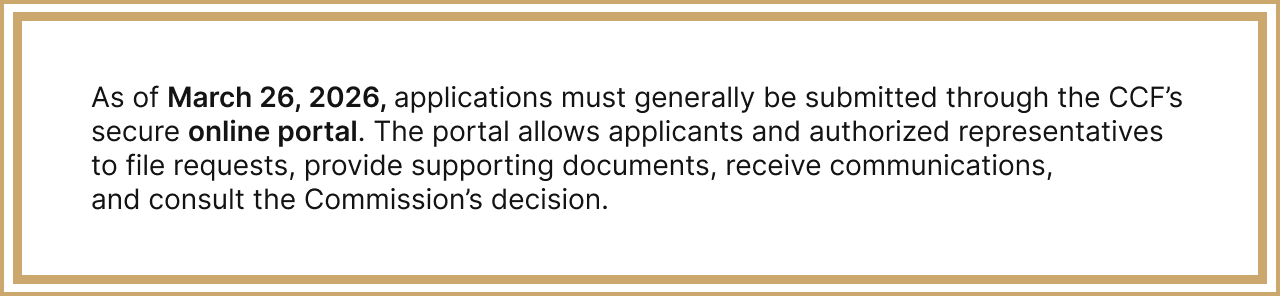
The process is primarily written. The CCF does not ordinarily conduct oral hearings, except in exceptional circumstances. Applicants should therefore present a clear legal memorandum, organized exhibits, and a coherent chronology at the outset.
The CCF does not charge a filing fee. It ordinarily decides access requests within four months after admissibility and correction or deletion requests within nine months after admissibility, subject to the procedures governing finalization and notification.
What Happens After Deletion?
When a Red Notice is deleted, INTERPOL removes it from its databases and circulates notifications to member countries. Where deletion is based on Article 2 or Article 3 concerns, the requesting National Central Bureau may also be advised not to use INTERPOL channels in the matter.
Deletion does not automatically cancel:
- The domestic criminal prosecution;
- The national arrest warrant;
- A domestic border alert;
- A bilateral extradition request;
- Information retained in national databases;
- Cooperation conducted outside INTERPOL.
Separate legal action may therefore be necessary in the requesting country and in countries where the person travels, resides, holds citizenship, or faces extradition exposure.
INTERPOL states that, after deletion, it may issue a certificate confirming that the person is no longer subject to a Red Notice. If travel difficulties continue, INTERPOL may remind the countries concerned of the deletion and the need to update their databases.
Conclusion
INTERPOL provides an essential mechanism for legitimate international police cooperation. Its systems should not, however, be used to export political persecution, punish dissent, seize disputed assets, collect private debts, or obtain leverage in commercial and personal conflicts.
Russia warrants particular scrutiny because international institutions have expressly called for vigilance regarding potentially politically motivated requests from the Russian National Central Bureau. Requests from China, Türkiye, Belarus, Azerbaijan, Kazakhstan, Tajikistan, Uzbekistan, Iran, Egypt, Bahrain, Rwanda, the United Arab Emirates, and other jurisdictions may also require careful examination depending on the circumstances.
Country of origin is relevant context, but it is not proof of abuse.
A successful challenge requires a case-specific showing that the data violate INTERPOL’s political-neutrality, human-rights, accuracy, purpose, proportionality, seriousness, or private-dispute requirements.