
 ES
 RU
 TR
 FA
 AR
 ZH
Blog
Blog description

ITAR Reform in 2026: Proposed USML Changes for Defense Suppliers
A purchase order arrives for a component a company has sold for years. The customer identifies a new defense program, and engineering reports that the requested version differs only in its mounting arrangement. Before committing to delivery, the supplier must determine whether its existing export classification still applies, whether the records support that conclusion, and what authorization the transaction requires.
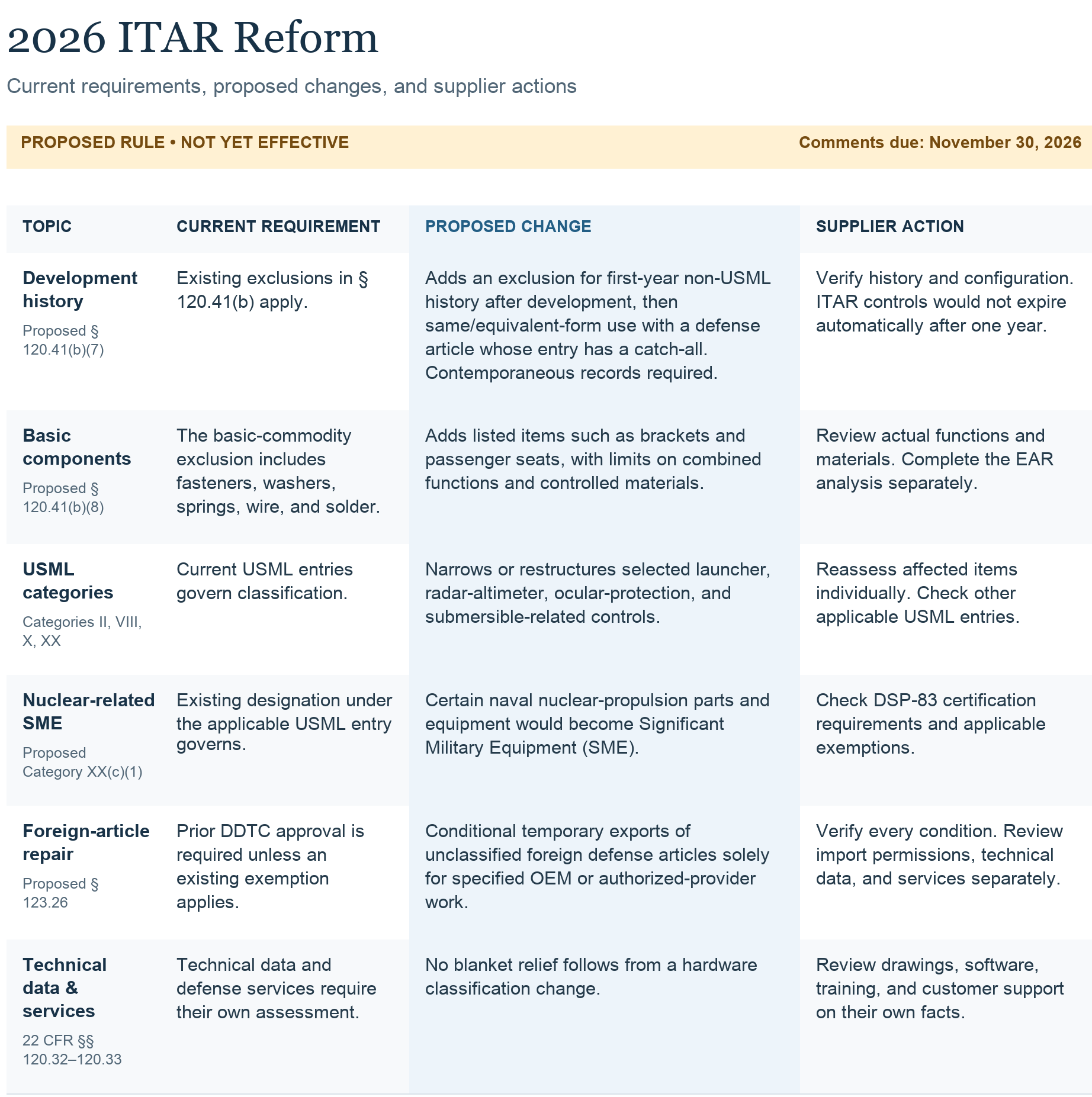
The State Department’s October 1, 2026 proposal would revise selected U.S. Munitions List (USML) entries, add two exclusions to the “specially designed” definition in the International Traffic in Arms Regulations (ITAR), and create a conditional exemption for certain temporary exports of foreign defense articles. Comments are due November 30, 2026. As of October 18, the amendments remain proposed, and current requirements continue to govern.
For suppliers serving commercial and defense markets, the significance extends beyond export paperwork. Classification affects contract opportunities, collaboration with overseas customers, and support after delivery. The central challenge is establishing which products or activities would qualify for relief and translating that determination into reliable commercial decisions. Engineering, compliance, and commercial teams each hold part of the evidence needed to reach that conclusion.
What Would the 2026 ITAR Proposal Change?
The proposal follows Executive Order 14268, issued April 9, 2025, which directed a USML review focused on the most sensitive technologies. The order also sought greater efficiency in foreign defense sales and emphasized considering exportability during design.
The category changes would remove certain smooth-bore, fixed-barrel canister launchers and most radar altimeters, revise ocular-protection controls, and restructure submersible-equipment provisions. Certain naval nuclear-propulsion items would newly receive Significant Military Equipment (SME) designation.
That designation can affect transaction documentation. Current § 123.10 generally requires a Form DSP-83 nontransfer and use certificate for SME exports under a license or other authorization, subject to specified exemptions. The certificate involves the applicant, foreign consignee, and foreign end-user. Suppliers evaluating the proposed designation would therefore need to consider the resulting certification requirements alongside classification.
The classification method remains important throughout this review. Under the current ITAR order of review, a supplier compares the item’s characteristics with the relevant USML entries. An article may be specifically enumerated or covered by a catch-all provision incorporating “specially designed.” An exclusion within that definition must be evaluated against the applicable entry; it does not override an independent enumerated control.
A catch-all reaches unspecified parts and components through their specially designed relationship to an enumerated item. Classification may therefore depend on what a component does, why it was developed, and the equipment with which it is used.
These distinctions make a product-by-product review necessary. “Aerospace components” and “marine equipment” may be useful starting categories, but they cannot establish that every item within a catalog would receive the same treatment.
The Proposed “Specially Designed” Exclusions: Conditions and Limits
The development-history exclusion
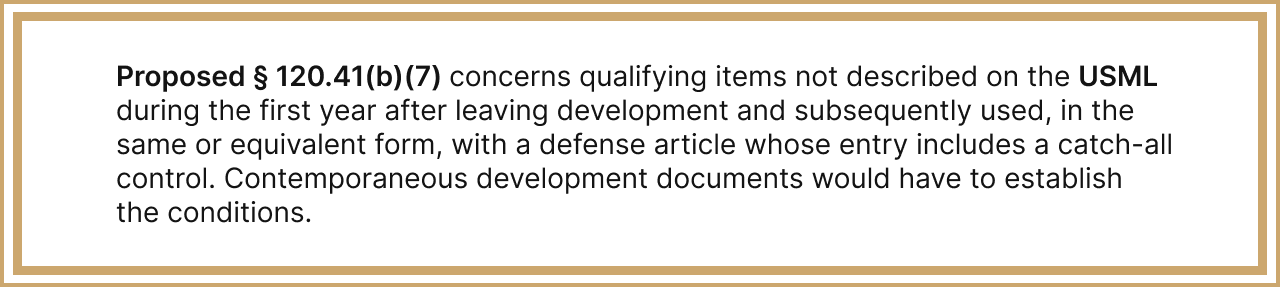
The first-year condition is a historical test. It would not cause ITAR controls to expire automatically after a year. A company would need to establish the relevant development milestone, the item’s control history, and the configuration involved in its subsequent use.
This would make chronology part of the legal analysis. A later purchase order may show where a component is going, but it may say little about the circumstances of its original development. Likewise, a current catalog description may identify a familiar product name without establishing that the configuration is the one addressed in older engineering records.
“Same or equivalent form” also requires careful examination. Current § 120.42 defines form by reference to configuration, material, and material properties; fit concerns physical interfaces. Equivalence addresses a form modification made solely for fit. A mounting change and a performance change therefore present different factual questions.
In the opening hypothetical, engineering’s statement that “only the mounting changed” should lead to a review of drawings and change records. Did the revision alter materials, operating limits, or function? Did the new application require additional features? The company needs an engineering explanation detailed enough to support the regulatory meaning of “same” or “equivalent.”
The exclusion for additional basic commodities
Proposed paragraph (b)(8) lists additional basic commodities, including brackets and passenger seats. Its combination rule would allow only functions listed in paragraphs (b)(2) and (b)(8). A bracket incorporating fasteners is an example of an eligible combination. USML-controlled coatings and materials would remain outside the exclusion.
Consider a purchasing system that groups several configurations under “bracket”: a simple mounting piece, an assembly with additional functions, and a version using different materials. The product description alone would not establish eligibility. Each configuration would need to be examined for its actual functions and materials, including whether any separately controlled feature remains relevant.
The proposal also lacks a parallel exclusion in the Export Administration Regulations’ (EAR) specially designed definition. A favorable ITAR analysis would therefore leave the applicable EAR analysis to be completed.
Why the Development Timeline and Supporting Records Matter
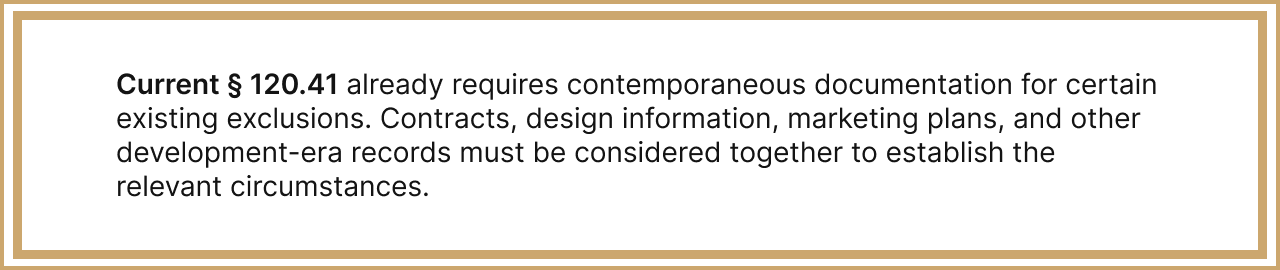
The proposed history-based exclusion would make a coherent development record particularly important for affected products.
An engineer’s recollection and a documented classification analysis serve different purposes. The engineer may remember the original design intent, while surviving records describe another version or omit a critical milestone. Acquisitions, staff departures, and changes in record systems can make these gaps harder to resolve. A review of older products should identify both the missing evidence and the material still available to address it.
The meaning of development is equally important. Current § 120.43 distinguishes development from production and recognizes that certain reliability, maintenance, quality, or cost improvements can occur while an item remains in production. New versions changing basic performance or capability receive different treatment.
For a manufacturer updating a sensor family, a process change intended to reduce scrap and a redesign intended to improve measurement capability may both be called “product improvements.” A classification review needs enough detail to distinguish those activities. Labels such as “released,” “qualified,” or “production ready” should be supported by an explanation of the milestones they represent.
Where jurisdiction remains uncertain, the Directorate of Defense Trade Controls’ (DDTC) commodity-jurisdiction procedure provides a formal means of determining whether an article or service falls on the USML. Accurate technical information and a clear development history are central to a well-supported request.
The Proposed Repair Exemption: A Defined Transaction Authorization
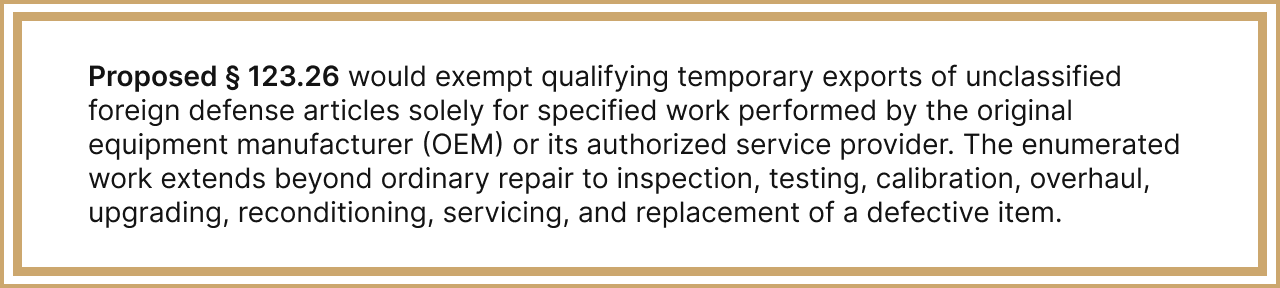
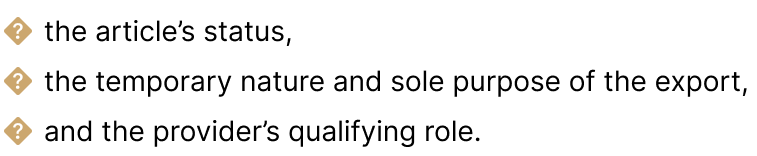
The inclusion of upgrades matters when evaluating a work order. An upgrade would not, by that description alone, make the transaction ineligible. The company would still need to establish:
Classification and permission to move an article remain separate questions.
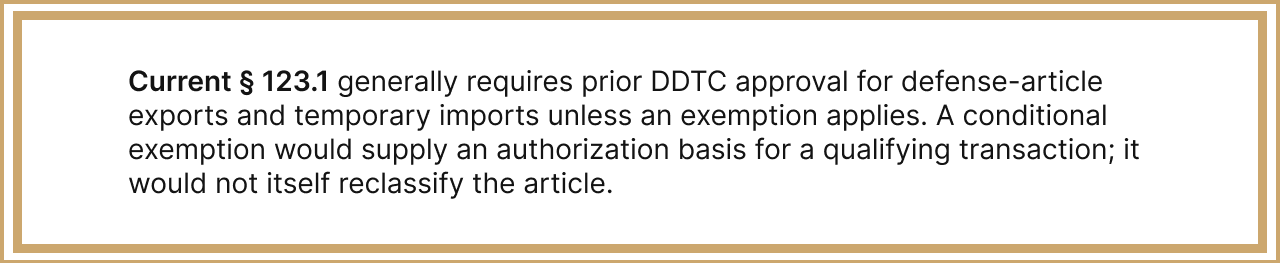
For a repair business, the review should connect the article, work order, recipient, and actual activities. “Return for repair” can describe arrangements with different regulatory consequences. A work order combining inspection, replacement, and customer training illustrates the issue: reviewing the hardware movement may leave a separate question about the information or assistance provided to the customer.
Import permissions must also be evaluated separately. The Bureau of Alcohol, Tobacco, Firearms and Explosives (ATF) administers permanent-import controls for articles on the U.S. Munitions Import List. An export exemption would not establish compliance with those requirements.
Technical Data and Defense Services Require Their Own Analysis
A supplier’s export activity can extend well beyond hardware.
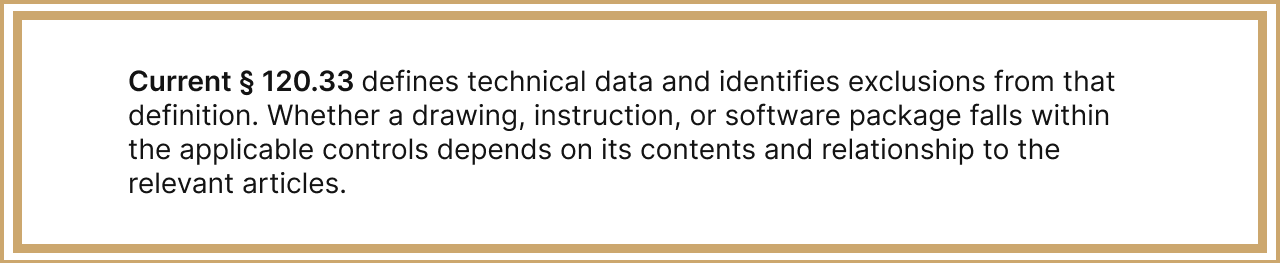
Suppose a customer folder contains a component drawing, installation instructions for a military platform, and detailed information about the platform’s controlled subsystems. A decision concerning the component alone would not classify the entire folder. Each document needs to be assessed for what it discloses and which product or subsystem it concerns.
Customer support creates a related issue.
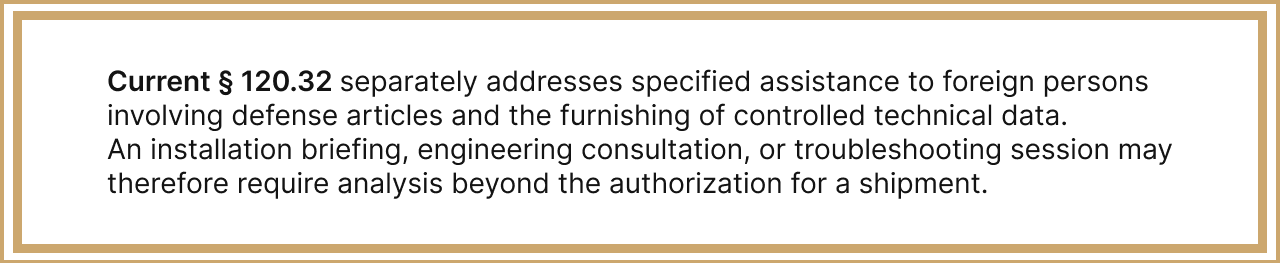
The operational task is to connect these conclusions to customer portals, engineering folders, training materials, and support channels. Employees need instructions that identify the information and activities covered by the company’s review and the points at which further approval is required.
What an EAR Classification Would Mean for Actual Transactions
For an item subject to the EAR, the company must determine its classification and assess the transaction. The Export Control Classification Number, where applicable, and destination inform the licensing analysis; restrictions may also depend on the parties, end use, and other circumstances.
Management can then evaluate what the result means for sales and deliveries. Several destinations, distributors, and customer applications may need review before the company can estimate the effect on market access or delivery schedules. A conclusion for one transaction should not be copied automatically to every sale of the same product.
Implementation extends to shipping instructions, customer questionnaires, contract language, and employee training. Each may refer to the existing treatment. The responsible teams should review these materials so that the classification database, operating procedures, and commercial representations remain consistent.
Historical transaction records should remain accessible. Current ITAR recordkeeping requirements cover relevant defense-article, technical-data, service, authorization, and exemption records. Preserving the decision history allows the company to explain what it shipped and the basis on which it acted at the time.
How Defense Suppliers Can Prepare While the Proposal Is Pending
Suppliers can prioritize configurations for which uncertainty has the greatest commercial effect. Engineering and compliance teams can identify the applicable control language, assemble development evidence, map related data and services, and assess prospective EAR treatment. Examining a manageable group of important products is more useful than treating broad catalog descriptions as classifications.
This work can also support substantive comments. Companies can identify ambiguous terms, explain configurations that are difficult to distinguish, or propose technical criteria that would make the regulation easier to apply. Concrete examples give the agency specific issues to evaluate. Submissions should be reviewed for sensitive information before filing.
Implementation should follow the final regulatory language, effective date, and applicable transition instructions. Companies can then approve supported classifications, determine the consequences for affected transactions and existing authorizations, and communicate the changes to the people responsible for executing them.
That sequence connects legal analysis to commercial planning. Product histories and supporting records become the basis for assessing international opportunities, preparing quotations, and making delivery commitments that the company’s export processes can support.
Frequently Asked Questions About the 2026 ITAR Proposal
Are the October 2026 proposed ITAR changes already effective?
No. As of October 18, 2026, the amendments remain proposed. Current requirements and authorization conditions continue to apply. Comments are due November 30, 2026; the comment deadline is not an effective date.
Would every component used in a military product qualify for relief?
No. The relevant USML entry, item characteristics, and exclusion conditions must be evaluated. A specially designed exclusion does not override an independent enumerated control. A military customer’s purchase order alone does not establish the item’s classification.
What evidence would support the proposed development-history exclusion?
Contemporaneous development documents would need to establish the conditions of proposed § 120.41(b)(7), including the relevant first-year history and qualifying subsequent use. Original requirements, engineering revisions, contracts, and related records should be assessed collectively against the particular configuration.
Would an item outside the USML automatically be exportable without a license?
No. If it is subject to the EAR, classification, destination, parties, and end use must be assessed. The result determines whether a license is required or an exception is available; EAR jurisdiction alone does not authorize a shipment.
Would a hardware classification change also cover drawings, software, and customer support?
Not automatically. Documents may contain information about other controlled items, and assistance may raise a separate defense-service question. The review should establish what information will be shared, which articles it concerns, and what personnel will do.
How would the proposed ITAR repair exemption work?
It would provide conditional licensing relief for qualifying temporary exports of unclassified foreign defense articles solely for specified OEM or authorized-provider work. Eligibility, associated assistance, and separate import permissions would still require review.
What can defense suppliers do before a final ITAR rule is issued?
Identify affected configurations, retrieve development records, review associated information and services, and assess possible EAR outcomes. Companies can also prepare comments and assign responsibility for monitoring the rulemaking. Those preparations should inform a later implementation decision under the final text and applicable transition instructions.
Conclusion
The proposal’s significance lies in how its conditions would apply to identifiable products and activities. A supplier must be able to explain the relevant control language, demonstrate the facts supporting an exclusion or exemption, and determine the consequences for the transaction it intends to undertake.
Preparation can begin with a defined product configuration and documented development history, then extend to technical information, customer support, licensing, and operating procedures. That approach gives management a firmer basis for evaluating opportunities while preserving a clear distinction between potential relief and currently authorized activity.
Companies that complete this work will be better prepared to turn future regulatory changes into dependable commercial decisions. Accurate classifications support quotations, delivery commitments, and customer relationships. Until applicable changes take effect, existing requirements and authorization conditions continue to govern.