
 ES
ES  RU
RU  TR
TR  FA
FA  AR
AR  ZH
ZH Blog
Blog description

OFAC Annual Report of Blocked Property (ARBP): What U.S. Persons Must File by September 30, 2026
Businesses, financial institutions, cryptocurrency companies, law firms, and other U.S. persons holding property blocked under U.S. sanctions should be aware of an important annual compliance deadline: September 30, 2026.
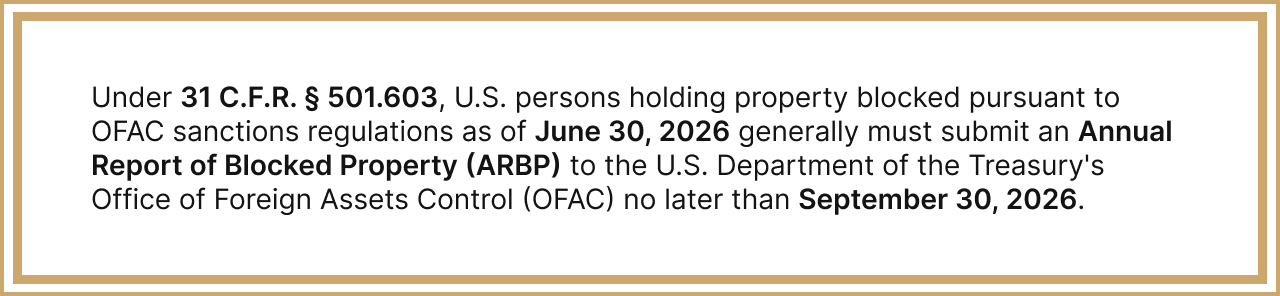
OFAC issued a specific reminder regarding the 2026 filing requirement on July 1, 2026.
The requirement can easily be overlooked because it is separate from the initial OFAC report generally required when property is first blocked.
In other words, filing an initial blocking report does not necessarily complete the reporting obligations associated with the blocked property.
If the property remained blocked as of June 30, it may also have to be included in the annual September 30 report.
What Is the OFAC Annual Report of Blocked Property?
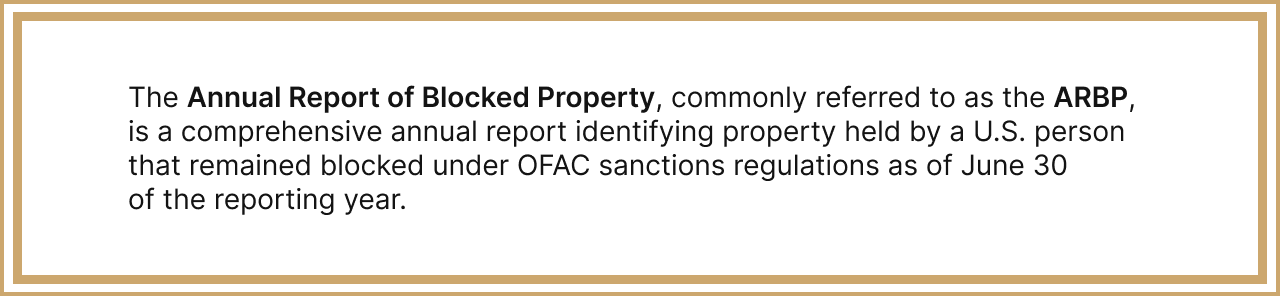
For 2026, the relevant snapshot date is:
June 30, 2026.
The filing deadline is:
September 30, 2026.
The governing requirement appears in OFAC's Reporting, Procedures and Penalties Regulations at 31 C.F.R. § 501.603.
The purpose of the annual reporting requirement is different from the initial reporting requirement that applies when property is first blocked.
Initial OFAC Blocking Report vs. Annual Report of Blocked Property
Understanding this distinction is critical.
|
Requirement |
Initial Blocking Report |
Annual Report of Blocked Property (ARBP) |
|
When triggered |
When property is blocked |
When blocked property remains held as of June 30 |
|
General deadline |
Within 10 business days of the blocking action |
September 30 |
|
Purpose |
Notify OFAC of the blocking action |
Provide OFAC with an annual inventory of blocked property |
|
2026 relevant date |
Depends on when the property was blocked |
Property held as of June 30, 2026 |
|
2026 deadline |
Generally 10 business days after blocking |
September 30, 2026 |
|
Does an earlier blocking report eliminate the ARBP requirement? |
No |
A separate annual filing may still be required |
This distinction is particularly important for organizations that blocked property months or years ago.
The fact that the transaction was already reported to OFAC does not necessarily mean that nothing further must be filed.
Who Must File the 2026 ARBP?
The requirement is not limited to banks.
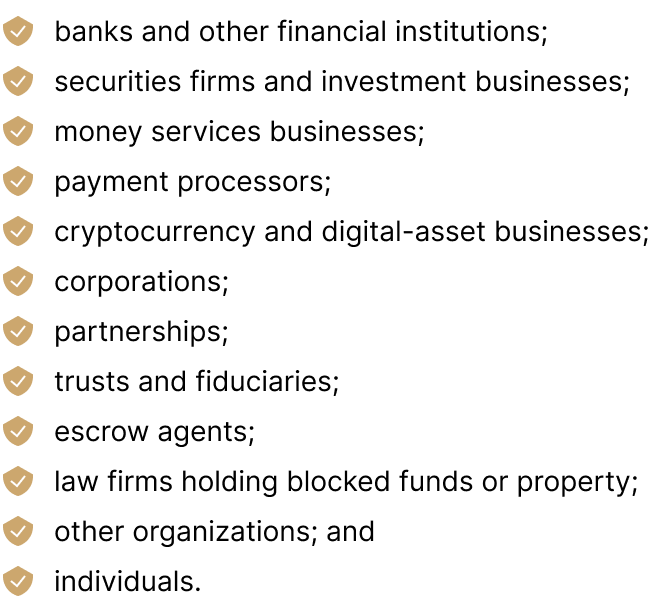
OFAC's July 1, 2026 notice states that U.S. persons holding blocked property as of June 30 of the current year must file the ARBP.
Depending on the circumstances, the requirement may therefore potentially apply to:
The key question is generally not whether the filer is a bank.
The key question is:
Did the U.S. person hold property blocked pursuant to OFAC regulations as of June 30, 2026?
If the answer is yes, the ARBP requirement should be evaluated.
What Counts as “Blocked Property”?
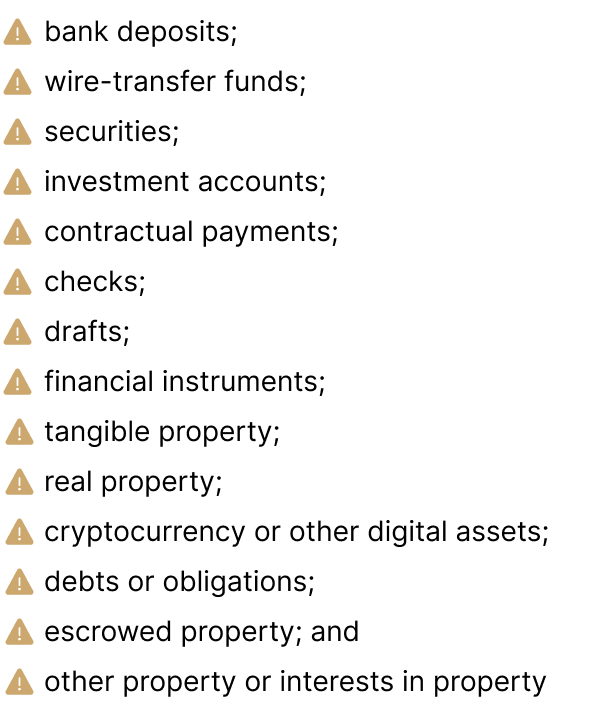
Blocked property can take many forms. It is not limited to cash sitting in a frozen bank account.
Depending on the applicable sanctions program and circumstances, blocked property may include:
The analysis can become particularly important when ownership is indirect.
Under OFAC's 50 Percent Rule, an entity may itself be treated as blocked when one or more blocked persons own, directly or indirectly and individually or in the aggregate, 50 percent or more of the entity.
Accordingly, an ARBP review should not necessarily be limited to property held directly in the name of a person appearing on OFAC's Specially Designated Nationals and Blocked Persons List (SDN List).
Beneficial ownership and indirect blocked interests may also require analysis.
What Property Should Be Reported for 2026?
The 2026 ARBP generally concerns property that was actually blocked as of June 30, 2026.
This cutoff date is extremely important. The report is not simply a list of every transaction that was blocked at any point during the year. Instead, it is an annual snapshot of blocked property held on June 30.
For example:
Example 1
A U.S. bank blocked $250,000 in February 2026, and the funds remained blocked on June 30, 2026.
The property generally falls within the 2026 ARBP reporting framework.
Example 2
A U.S. company blocked a payment in January 2026. OFAC subsequently issued a specific license, and the property was unblocked in May 2026.
Because the property was no longer blocked as of June 30, 2026, it generally should not be included in the 2026 ARBP.
Example 3
A financial institution has held property blocked since 2023, and the property remained blocked on June 30, 2026.
The age of the original blocking does not eliminate the annual reporting requirement. If the property remained blocked on the relevant reporting date, it may need to appear again in the 2026 ARBP.
What Property Should Not Be Included?
This is another area where OFAC's 2026 guidance is particularly useful.
OFAC expressly states that –

This applies even where operational steps associated with returning or transferring the property may not yet have been completed.
Similarly, property previously blocked pursuant to a sanctions program that was terminated on or before June 30, 2026 is not considered blocked property for purposes of the 2026 ARBP.
The distinction between blocked property and property that was previously blocked but subsequently authorized for release is therefore important.
Special Issue: Restricted Iranian Accounts
OFAC's 2026 reminder specifically addresses another issue that can cause confusion.
A restricted account belonging to a person ordinarily resident in Iran is not automatically considered blocked property for purposes of the ARBP.
Accordingly, such an account generally should not be reported merely because it is restricted.
However, the analysis changes if a person whose property and interests in property are blocked under applicable sanctions authority has an interest in the account.
This illustrates a broader principle:

What If No Blocked Property Was Held on June 30?
OFAC's 2026 guidance is clear on this point.
Persons who did not hold blocked property as of June 30, 2026 do not need to file an ARBP.
Accordingly, there is generally no requirement to submit a zero report merely because an organization previously blocked property during the year if no reportable blocked property remained as of June 30.
This makes the June 30 inventory analysis central to determining whether a filing obligation exists.
How Is the 2026 ARBP Filed?
OFAC requires persons filing the 2026 ARBP to use the current spreadsheet version of:
Form TD-F 90-22.50 — Annual Report of Blocked Property.
OFAC's 2026 guidance directs filers to:
- Download the current version of Form TD-F 90-22.50;
- Complete all mandatory fields in Parts A and B of the spreadsheet; and
- Submit the completed report through the OFAC Reporting System (ORS).
First-time ORS filers should pay particular attention to the registration process.
OFAC's 2026 guidance instructs first-time filers to contact OFAC to request ORS registration instructions and provide the organization's name and the name and email address of the primary person responsible for filing reports.
Organizations should therefore not wait until September 30 to begin the process.
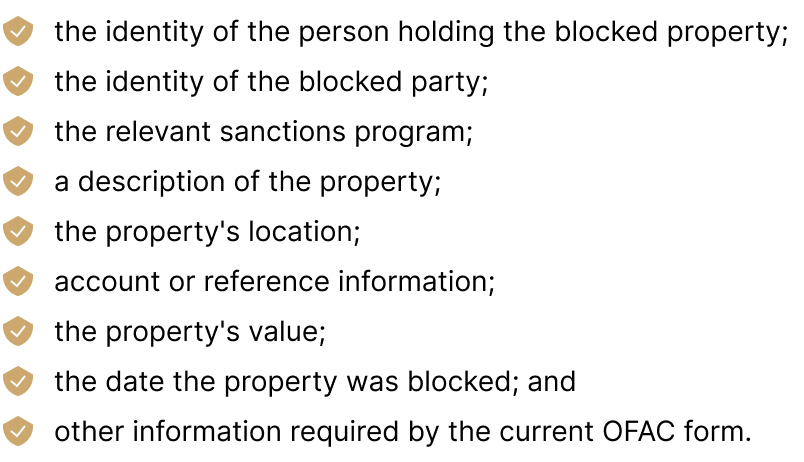
What Information Is Included in the ARBP?
The report requires information identifying both the holder of the blocked property and the blocked property itself.
Depending on the property and applicable sanctions program, the required information can include matters such as:
Organizations with multiple blocked accounts or assets should reconcile their internal records carefully before submitting the report.
The ARBP should not simply be generated from an old sanctions spreadsheet without confirming whether each item remained legally blocked as of June 30, 2026.
Common ARBP Filing Problems
OFAC's 2026 guidance specifically states that it is intended to help filers avoid common errors that can result in returned submissions.
Several issues deserve particular attention.
1. Reporting Property That Was Already Unblocked
A company may continue to classify property internally as “OFAC blocked” even after an OFAC general or specific license authorized its release.
That can result in inaccurate annual reporting.
The legal status of each asset should therefore be reviewed as of June 30.
2. Omitting Older Blocked Property
The ARBP is not limited to property first blocked during 2026.
Property blocked in an earlier year that remained blocked on June 30, 2026 may still need to be reported.
3. Confusing Rejected Transactions With Blocked Property
A rejected transaction and blocked property are legally different concepts.
A transaction that was rejected and returned is not necessarily property held by the institution for purposes of the ARBP.
Organizations should therefore avoid treating every sanctions-related transaction as blocked property.
4. Failing to Analyze Beneficial Ownership
A counterparty may not appear by name on the SDN List but may nevertheless be blocked under OFAC's ownership rules.
A proper review may therefore require analysis of ownership structures rather than simple list screening.
5. Waiting Until September 30 to Access ORS
First-time filers may need to obtain registration instructions.
Organizations should confirm their ORS access well before the deadline.
6. Assuming the Initial Blocking Report Was Enough
This may be one of the easiest mistakes to make.
The initial report and annual report serve different functions and operate on different deadlines.
A property holder may therefore have correctly submitted the original blocking report and still violate OFAC reporting requirements by failing to submit the required ARBP.
What If the Property Was Unblocked After June 30 but Before September 30?
The June 30 snapshot date is crucial.
Suppose property remained blocked on June 30, 2026, but OFAC authorized its release on August 15, 2026.
The fact that the property was subsequently released does not change what its status was on June 30.
Accordingly, organizations preparing the 2026 ARBP should focus carefully on the legal status of the property as of the reporting snapshot date, rather than simply reviewing what remains blocked on the September filing date.
This is one reason maintaining accurate historical sanctions records is important.
Is the ARBP the Same as the Initial 10-Business-Day OFAC Report?
No.
OFAC generally requires blocking and reject reports under 31 C.F.R. §§ 501.603 and 501.604 to be submitted within 10 business days of the relevant action.
The ARBP is an additional annual requirement applicable to blocked property held as of June 30.
Thus, a single item of blocked property can potentially generate more than one reporting event:
First: an initial blocking report shortly after the property is blocked.
Second: an ARBP if the property remains blocked as of June 30.
Third: additional reporting or recordkeeping obligations may arise depending on what subsequently happens to the property.
Organizations should therefore think of OFAC reporting as an ongoing compliance process rather than a single filing made when funds are initially frozen.
What Happens If You Miss the September 30 Deadline?
The deadline should be taken seriously.
OFAC expressly states in its 2026 reminder that:
Failure to file the required ARBP by September 30 constitutes a violation of the Reporting, Procedures and Penalties Regulations.
A missed filing should therefore not simply be ignored.
The appropriate response will depend on the circumstances, including the reason for the failure, the amount and nature of the property, the applicable sanctions program, the duration of the delay, whether the omission affected one asset or an entire portfolio, and the organization's broader OFAC compliance history.
Where a reporting failure is discovered, the organization should consider promptly assessing the deficiency and determining the appropriate corrective approach.
Why Businesses Other Than Banks Should Pay Attention
The phrase “blocked property” often causes businesses to assume that the annual reporting requirement is primarily a banking issue.
That assumption can be dangerous.
A U.S. company may hold blocked property because it:
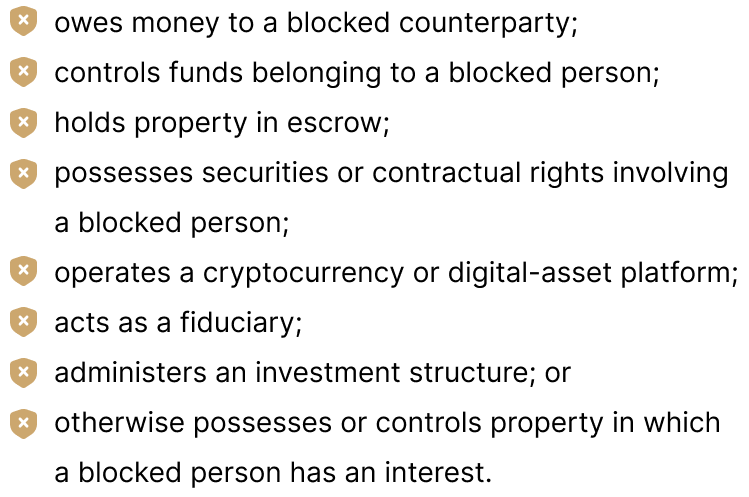
The reporting analysis therefore depends on the underlying property interest and applicable sanctions regulations—not simply on the industry in which the U.S. person operates.
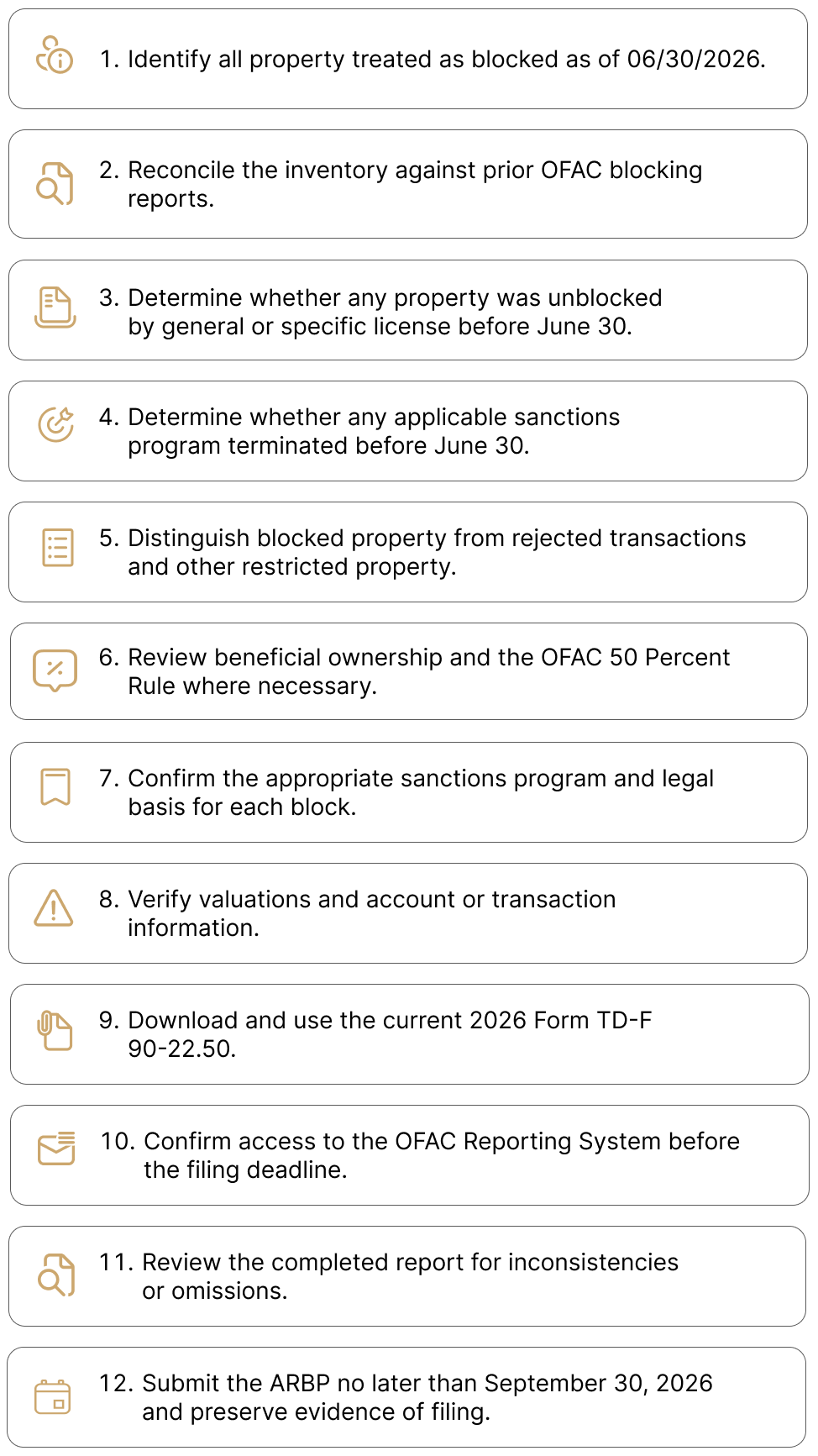
A Practical 2026 ARBP Compliance Checklist
Organizations potentially holding blocked property should consider completing the following review well before September 30:
Frequently Asked Questions About the 2026 OFAC Annual Report
When is the 2026 OFAC Annual Report of Blocked Property due?
The 2026 ARBP is due September 30, 2026.
What is the relevant reporting date?
The report covers blocked property held as of June 30, 2026.
Do I need to file if I did not hold blocked property on June 30, 2026?
Generally, no. OFAC states that persons who did not hold blocked property as of June 30 do not need to file an ARBP.
Do banks have to file the ARBP?
Banks holding blocked property may be subject to the requirement, but the obligation is not limited to banks. Other U.S. persons holding blocked property may also have reporting obligations.
Do I report property that OFAC already authorized for release before June 30?
Generally, no. OFAC's 2026 guidance states that property unblocked by a general or specific license is not considered blocked property for ARBP purposes.
Do I include property that was blocked years ago?
Potentially, yes. If property remained blocked as of June 30, 2026, the fact that the original blocking occurred in an earlier year does not by itself remove it from the annual reporting requirement.
Do rejected transactions go on the ARBP?
Not merely because they were rejected. The ARBP concerns blocked property held as of June 30, and blocked and rejected transactions are different concepts under OFAC regulations.
Is filing the initial OFAC blocking report enough?
Not necessarily. If the property remains blocked as of June 30, an Annual Report of Blocked Property may also be required.
What form must be used for the 2026 ARBP?
OFAC requires filers to use the current spreadsheet Form TD-F 90-22.50.
How is the report submitted?
OFAC's 2026 guidance instructs filers to submit the completed form through the OFAC Reporting System (ORS).
What happens if the ARBP is filed late?
OFAC states that failure to submit a required ARBP by September 30 constitutes a violation of the Reporting, Procedures and Penalties Regulations.
Key Takeaways
The 2026 OFAC Annual Report of Blocked Property is due September 30, 2026.
The report applies to U.S. persons holding property blocked pursuant to OFAC sanctions regulations as of June 30, 2026.
The requirement is not limited to financial institutions.