
 ES
ES  RU
RU  TR
TR  FA
FA  AR
AR  ZH
ZH Blog
Blog description

When Sanctions Evasion Becomes an AML Problem: Lessons From the A7 Network
An established supplier asks a U.S. buyer to send payment to an unfamiliar company in another country. The goods and price remain unchanged, but the recipient does not appear in the original contract. The supplier describes the arrangement as a convenient settlement mechanism. Sanctions screening produces no match.
This illustrative transaction raises a question that screening alone cannot answer: whose interests does the payment actually serve?
The U.S. Department of the Treasury’s October 1, 2026 action against the A7 Network brings that question into focus. The Office of Foreign Assets Control (OFAC) designated the network as a significant transnational criminal organization, while the Financial Crimes Enforcement Network (FinCEN) issued an alert and proposed a separate restriction on transfers involving its sub-agents. Treasury describes A7 as a Russia-linked network used by sanctioned actors, including Iranian actors, to move funds through disguised commercial arrangements.
For businesses, financial institutions, and their counsel, the action demonstrates how sanctions exposure can arise from the same unexplained payment relationships that warrant anti-money laundering (AML) review.
The A7 Action: Existing Sanctions and a Pending Transfer Restriction
The October 1 announcement encompasses distinct government actions with different legal consequences.
OFAC’s designation already applies. Treasury states that the A7 Network’s property and interests in property in the United States or in the possession or control of U.S. persons are blocked. This includes transactions involving sub-agents acting for or on the network’s behalf. Applicable authorizations and exemptions remain relevant when assessing a particular transaction.
FinCEN’s transfer restriction remains proposed. Published on October 5 under section 9714(a) of the Combating Russian Money Laundering Act, the proposal concerns transactions involving companies operating outside the United States that are controlled by A7.
It would prohibit covered financial institutions’ transfers, including convertible virtual currency, involving identified sub-agents and their administered accounts or addresses. FinCEN proposes distributing identification lists securely through its FI-Portal, alongside risk-based diligence, notification, and related recordkeeping requirements. The proposal would not create a separate reporting obligation beyond existing law. Comments are due November 4, 2026.
As of October 12, FinCEN continues to list the measure as proposed.

How an Intermediary Can Obscure the Underlying Transaction
According to FinCEN, an A7 customer supplies transaction information, including supplier details and trade documents. The network assigns a sub-agent to appear as the contracting or paying party on external documents. Payment can move through a non-Russian bank account, while settlement within the network uses other mechanisms, including digital assets. This arrangement obscures the underlying customer’s involvement from the institutions processing the payment.
The result is a gap between the economic relationship and the payment record. A bank may see one company paying another, while the customer benefiting from the payment is absent from the documents it receives.
A transaction may therefore warrant scrutiny even when the shipment is real and the visible companies are properly registered. Shipping records establish that goods moved. Corporate registration establishes that an entity exists. Neither fact, standing alone, explains whom the payment agent represents.
FinCEN identifies indicators including:
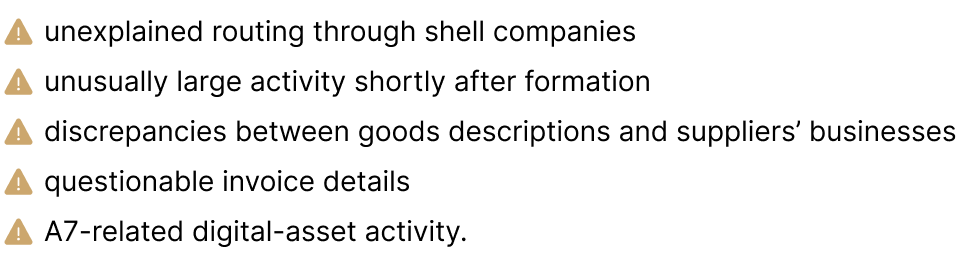
It emphasizes that no single indicator determines whether activity is suspicious.
These indicators provide starting points for investigation. The objective is to establish a commercial explanation supported by evidence and identify facts that require further legal analysis.
Sanctions Exposure, Reporting Obligations, and Criminal Liability Are Distinct
An unexplained payment arrangement can raise several legal questions. Each requires a separate assessment.
Sanctions restrictions
Sanctions review examines whether the parties, property interests, or activity bring a transaction within an applicable prohibition.
A counterparty’s absence from the Specially Designated Nationals and Blocked Persons List does not end that inquiry. Under OFAC’s 50 Percent Rule, entities owned directly or indirectly, 50 percent or more in the aggregate, by blocked persons are generally blocked even if they are not separately named.
Control alone does not automatically block an entity under that ownership rule. A particular transaction may nevertheless involve a blocked person’s property interest or an agent acting on that person’s behalf. Ownership, control, and agency therefore require separate analysis.
Treasury also notes that OFAC may impose civil penalties on a strict-liability basis. Lack of knowledge is therefore not a complete answer to potential civil exposure. IEEPA’s criminal provision addresses a different standard involving willful conduct.
Suspicious activity reporting
For banks, 31 C.F.R. § 1020.320 generally requires reporting of qualifying suspicious transactions conducted or attempted through them when funds or assets total at least $5,000, including aggregated amounts, and the bank knows, suspects, or has reason to suspect a listed condition.
Those conditions include illegal proceeds, evasion of Bank Secrecy Act requirements, and transactions with no apparent lawful purpose for which examination reveals no reasonable explanation. Other institution types have their own reporting rules.
A Suspicious Activity Report (SAR) does not require proof of criminal guilt. A red flag also does not automatically require a report without application of the relevant criteria.
Criminal money laundering
Certain IEEPA offenses are included among the specified unlawful activities in 18 U.S.C. § 1956(c)(7)(D). Sanctions evasion can therefore support a money laundering prosecution when the applicable statutory elements and jurisdictional requirements are established.
The elements vary by theory. Section 1956(a)(1) concerns transactions involving criminal proceeds, with the required knowledge and additional statutory purpose or knowledge. Section 1956(a)(2)(A) addresses qualifying transfers to or from the United States intended to promote specified unlawful activity; its text does not require criminal proceeds.
An administrative designation, unusual payment route, or SAR does not itself establish criminal liability. The distinction between a prohibited transaction, reportable suspicion, and a proven offense should remain clear throughout an investigation.
What Transaction Due Diligence Should Establish
For the buyer in the opening example, the immediate concern is the unexplained introduction of a third-party recipient.
Depending on the risk, a review could examine:
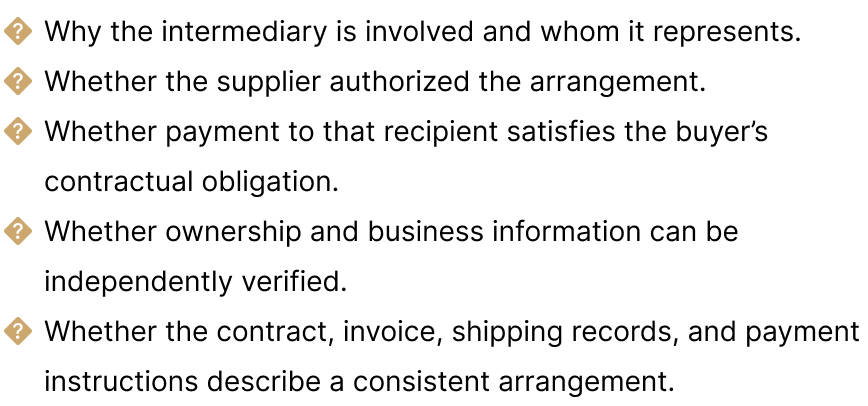
These inquiries have commercial value as well as compliance value. Paying an unauthorized recipient can create a dispute over whether the buyer satisfied its obligation. Establishing the agent’s authority helps clarify both payment legitimacy and the relationship relevant to sanctions review.
Document consistency matters. A file containing numerous invoices and corporate records may still leave the recipient’s role unexplained. Reviewers should identify the missing fact and obtain evidence that addresses it.
FFIEC guidance identifies unrelated third-party payments, unjustified changes to beneficiaries or payment locations, and inconsistent trade documentation among indicators warranting further scrutiny. These are contextual indicators rather than automatic findings of misconduct.
A business’s procedures should specify who may approve material changes to payment instructions, when compliance or legal review is required, and how unresolved discrepancies are escalated. Procurement and accounts-payable personnel should understand that process because they may encounter the issue before a compliance specialist does.
Implications for Banks, Payment Firms, and Compliance Governance
Financial institutions should evaluate an unexpected intermediary against the customer’s expected activity.
FFIEC customer due diligence guidance connects the nature and purpose of the relationship, the customer risk profile, and ongoing monitoring. Material changes in counterparties, transaction volumes, or payment arrangements may justify additional information and reassessment under risk-based procedures.
The review should reflect the institution’s role and the information available to it. An issuing bank, advising bank, and payment bank may hold different documents. The commercial buyer may possess supplier communications that never reach any of them. FFIEC trade-finance guidance recognizes that documentary review depends on the bank’s role.
Targeted information requests are therefore important. Repeatedly collecting the same corporate records may leave the actual principal or payment agent’s authority unresolved.
Relevant findings must also reach the appropriate reviewers. Sanctions, AML, trade, and operations personnel should have a defined means of sharing transaction evidence, subject to applicable confidentiality restrictions. A concern about one recipient may become more significant when considered alongside activity across accounts or documents held elsewhere in the organization.
Control testing can examine whether that exchange occurs in practice. A recipient-change scenario can reveal whether staff recognize the issue, obtain relevant evidence, identify the decision-maker, and preserve the reasoning before deciding how to handle the transaction. This is a practical recommendation informed by OFAC’s compliance framework, rather than a new A7-specific mandate.
Finally, the operational response must follow the applicable obligation. Where blocking is required, funds cannot simply be returned as an ordinary rejected payment. Filing a SAR does not authorize a prohibited transaction or replace a required OFAC report. FFIEC guidance likewise distinguishes suspicious activity reporting from sanctions restrictions that may require a transaction to be stopped.
Frequently Asked Questions
Does a clean sanctions-screening result establish that a payment is permissible?
No. An unlisted entity may be blocked under OFAC’s 50 Percent Rule, and a transaction may involve a blocked person’s property interest through an intermediary. Review should address ownership, the recipient’s authority, and the underlying relationship as appropriate to the risk.
Does suspected sanctions evasion automatically establish money laundering?
No. Criminal money laundering requires proof of the applicable statutory elements and jurisdictional requirements. Certain sanctions offenses can support a prosecution, but suspicious routing, a designation, or a SAR does not establish criminal liability.
Must an ordinary commercial business file a SAR?
A business does not acquire a general SAR obligation merely because it conducts international trade. Reporting requirements depend on the applicable financial-institution rules. A commercial buyer should nevertheless assess sanctions obligations, investigate unexplained arrangements, and document the basis for its payment decision.
What should a company examine when a supplier requests payment to a third party?
The review should establish why the recipient is involved, whom it represents, and whether payment to it satisfies the contractual obligation. Depending on the risk, useful evidence may include the intermediary’s mandate, verified ownership information, and reconciliation of the contract, invoice, shipping records, and payment instructions.
Does using a stablecoin eliminate sanctions exposure?
No. The asset, parties, and transaction remain relevant. Treasury identifies A7A5 as a blocked, ruble-backed token issued by Old Vector LLC, an entity designated in August 2025. More broadly, using a stablecoin does not itself establish misconduct; the arrangement must be assessed on its facts.
Does filing a SAR resolve the sanctions issue?
No. Reporting suspicion and deciding how to handle a transaction are separate matters. A SAR does not replace a required OFAC report. For U.S. persons holding blocked property, OFAC generally requires an initial blocking report within 10 business days.
For SARs connected to the A7 alert, FinCEN requests FIN-2026-A7NETWORK in field 2 and the narrative. Institutions must also observe applicable SAR confidentiality requirements.
Is FinCEN’s A7 transfer restriction already effective?
As of October 12, 2026, it remains proposed. Comments are due November 4, 2026. The existing OFAC designation has current legal consequences, and institutions should continue applying applicable sanctions and Bank Secrecy Act obligations while monitoring the rulemaking.
Conclusion
The A7 action illustrates how an apparently ordinary commercial payment can conceal a relationship that matters under both sanctions and AML requirements.
Effective review requires an explanation of why an intermediary participates, whom it represents, and whose interests the payment serves. That explanation should be supported by evidence and available to the people making sanctions, reporting, and payment decisions.
Businesses and financial institutions should assess whether their procedures bring those facts together, preserve unresolved discrepancies, and assign responsibility for the response. The decision should distinguish current restrictions from proposed requirements and align the legal response with the evidence.
The central lesson is practical: understanding the relationship behind a payment is essential to understanding its risk.