
 Turkish
  English
  Español
  Русский
  Persian (فارسی)
  Arabic (العربية)
  简体中文 (中国)
Doing Business in Venezuela Under OFAC General Licenses: What U.S. Persons May and May Not Do Without a Specific License
U.S. sanctions involving Venezuela remain complex, highly fact-specific, and subject to frequent change. Although the Office of Foreign Assets Control (“OFAC”) has issued a number of Venezuela-related General Licenses, those authorizations are not a complete lifting of sanctions.
Most recently, on April 14, 2026, OFAC issued Venezuela General License 56, titled “Authorizing Commercial-Related Negotiations of Contingent Contracts with the Government of Venezuela,” and Venezuela General License 57, titled “Authorizing Financial Services Transactions Involving Certain Venezuelan Banks and Government of Venezuela Individuals.”
These new General Licenses create limited authorizations for certain commercial negotiations and financial-services transactions involving Venezuela. However, they do not authorize all transactions with the Government of Venezuela, Venezuelan state-owned entities, Venezuelan banks, or sanctioned persons. Businesses, financial institutions, investors, consultants, and service providers should carefully determine whether their proposed activity falls within an existing General License or whether a specific OFAC license is required.
What Is an OFAC General License?
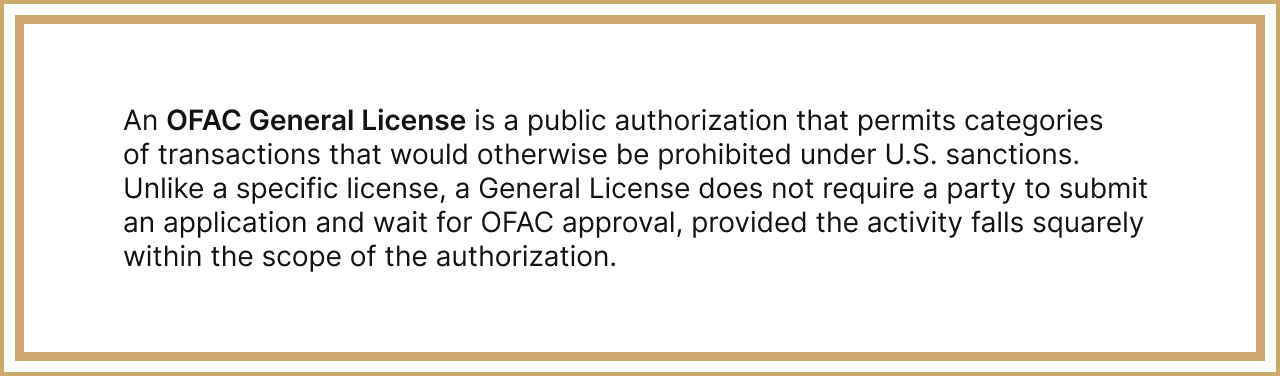
However, General Licenses are self-executing only when all conditions are satisfied. They must be read narrowly. If a transaction exceeds the authorization, involves excluded parties, includes prohibited payment terms, or touches blocked property not covered by the license, the parties may still face sanctions risk.
In other words, the existence of a General License does not mean that the transaction is automatically lawful. It means only that OFAC has authorized a defined category of conduct, subject to the conditions and limitations stated in the license.
Venezuela Sanctions: The Basic Rule
The Venezuela sanctions program includes blocking sanctions affecting the Government of Venezuela and certain Venezuelan state-owned or state-controlled entities. U.S. persons are generally prohibited from engaging in transactions involving blocked persons unless the transaction is exempt or authorized by OFAC.
The term “Government of Venezuela” is broad. It may include the state and government, political subdivisions, agencies, instrumentalities, state-owned entities, persons owned or controlled by the foregoing, and persons acting for or on behalf of the Government of Venezuela.
Accordingly, a transaction may involve a blocked interest even where the counterparty is not individually listed on OFAC’s Specially Designated Nationals and Blocked Persons List (“SDN List”). This is one of the most common compliance issues in Venezuela-related matters.
Recent Venezuela General Licenses Issued by OFAC
On April 14, 2026, OFAC issued Venezuela General License 56 and Venezuela General License 57.
General License 56 authorizes certain transactions related to commercial negotiations of contingent contracts with the Government of Venezuela. General License 57 authorizes certain financial-services transactions involving specified Venezuelan banks and certain Government of Venezuela individuals.
These issuance dates are important because OFAC General Licenses may be amended, replaced, suspended, or revoked. Parties should always confirm that the relevant license remains in effect at the time of the proposed transaction and should not rely on outdated versions of OFAC authorizations.
General License 56: Commercial Negotiations of Contingent Contracts

This is a significant but limited authorization. GL 56 permits negotiation activity, but it does not authorize full performance of the contract. Any contract negotiated under GL 56 must be expressly contingent on separate OFAC authorization before entry into and performance.
In practical terms, GL 56 may allow parties to discuss commercial terms, prepare draft documents, submit bids or proposals, negotiate memoranda of understanding, or reach agreements in principle, provided the relevant documents are structured as contingent on future OFAC authorization.
However, GL 56 does not authorize parties to start performance, deliver goods or services, receive or make payments, transfer blocked property, enforce judgments, or implement a transaction unless a separate OFAC authorization applies.
Practical Meaning of GL 56
GL 56 may be useful where a U.S. or non-U.S. company wants to explore a possible transaction involving the Government of Venezuela but cannot lawfully perform that transaction without OFAC authorization.
For example, GL 56 may support preliminary negotiations, diligence, legal review, drafting of non-binding or conditional documents, and preparation of a specific license application. But the final commercial transaction must remain contingent. The parties should avoid language suggesting that performance is already authorized or unconditional.
A properly drafted contingent contract should make clear that no party is obligated to perform, no payment is due, and no goods or services will be provided unless and until OFAC issues a separate specific license or another applicable authorization exists.
Key Limitations Under GL 56
GL 56 contains important restrictions. It does not authorize all dealings with the Government of Venezuela. It does not authorize transactions otherwise prohibited by the Venezuela Sanctions Regulations unless they are specifically covered by the license.
The license also does not authorize certain debt, bond, settlement, or collateral-related transactions involving the Government of Venezuela or Petróleos de Venezuela, S.A. (“PdVSA”), unless separately authorized.
GL 56 also excludes certain payment structures, including payment terms that are not commercially reasonable, debt swaps, payments in gold, and payments denominated in digital currency, digital coins, or digital tokens issued by or on behalf of the Government of Venezuela, including the petro.
The license also contains restrictions involving certain high-risk jurisdictions and restricted parties. Transactions involving sanctioned persons, SDNs, entities owned 50 percent or more by SDNs, or excluded jurisdictions may remain prohibited.
General License 57: Financial Services Involving Certain Venezuelan Banks and Government Individuals

The listed institutions include the Banco Central de Venezuela, Banco de Venezuela, Banco Digital de los Trabajadores Banco Universal C.A., Banco del Tesoro, and entities owned 50 percent or more by those institutions.
GL 57 also covers certain individuals blocked solely because they meet the definition of Government of Venezuela, such as current Government of Venezuela employees, provided they are not listed on the SDN List.
The term “financial services” is broad and may include maintaining or closing accounts, loans, transfers of funds, banking services, money transmission, deposits, insurance, guarantees, ACH transfers, wire transfers, payment cards, digital wallets, currency exchange, U.S. dollar banking, correspondent banking, remittances, payroll-related payments, cybersecurity and fraud-prevention services, investments, securities, and commodity futures or options.
What GL 57 Does Not Authorize
GL 57 should not be treated as a blanket authorization for all financial transactions involving Venezuela.
Most importantly, GL 57 does not unblock property blocked under OFAC sanctions. It also does not authorize transactions otherwise prohibited by the Venezuela Sanctions Regulations unless those transactions are separately authorized.
Therefore, banks, payment processors, companies, and individuals should not assume that GL 57 permits any payment merely because a Venezuelan bank is involved. The transaction must involve covered parties, covered financial services, and no excluded conduct.
Separate sanctions screening, ownership review, payment-chain analysis, and transaction-level legal review remain essential.
When Is a Specific OFAC License Still Required?
A specific OFAC license may be required where the proposed activity is not fully covered by an existing General License.
Common examples include:
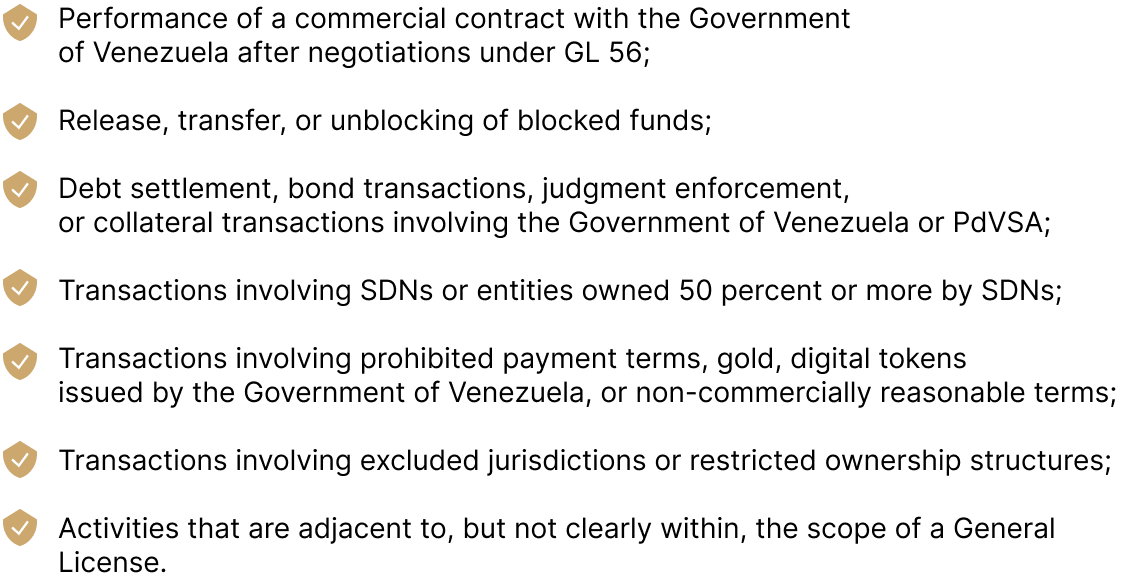
OFAC’s specific licensing process allows parties to request authorization for transactions that would otherwise be prohibited. In complex Venezuela matters, it is often prudent to seek legal review before submitting an application, entering into any contingent contract, processing payments, or relying on a General License.
Compliance Risks for Companies and Financial Institutions
The main compliance risk is overreliance on a General License. A company may correctly identify that a General License exists but incorrectly assume that the license covers the entire transaction.
For Venezuela-related matters, this risk is especially significant because the Government of Venezuela definition is broad, ownership structures may be opaque, and many transactions involve banks, intermediaries, public-sector entities, or state-controlled counterparties.
Financial institutions should also be cautious when processing payments. Even if a payment appears to involve a covered Venezuelan bank, the underlying purpose of the payment, the parties, the beneficial owners, the payment route, and the source of funds may still create sanctions exposure.
Practical Compliance Steps
Before relying on a Venezuela General License, parties should conduct a structured sanctions analysis. This should include identifying:
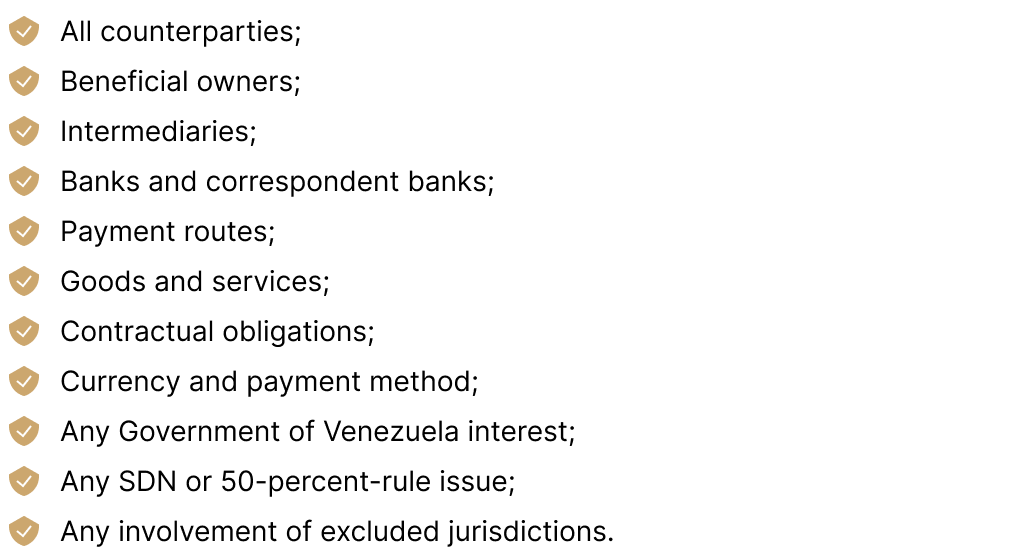
For GL 56, any draft contract should expressly state that entry into and performance are contingent on separate OFAC authorization. No performance should begin until the parties confirm that a valid authorization exists.
For GL 57, financial institutions should confirm that the transaction involves covered financial services and does not involve blocked property or otherwise prohibited activity.
Importance of Legal Review
Venezuela General Licenses should be interpreted carefully and conservatively. A small factual difference may change the legal conclusion.
For example, preliminary negotiations may be authorized, but contract performance may not be. A banking transaction may be authorized for one Venezuelan institution but not for another. A payment may be permissible if it involves ordinary financial services but prohibited if it involves blocked property, debt settlement, or an SDN-owned entity.
For that reason, parties should obtain sanctions counsel review before relying on GL 56 or GL 57 in any material transaction.
Conclusion
OFAC’s Venezuela General Licenses create meaningful but limited opportunities for engagement with Venezuela.
General License 56, issued on April 14, 2026, permits certain commercial negotiations of contingent contracts with the Government of Venezuela, but it does not authorize entry into or performance of the underlying contract unless separate OFAC authorization is obtained.
General License 57, also issued on April 14, 2026, authorizes certain financial-services transactions involving specified Venezuelan banks and certain Government of Venezuela individuals, but it does not unblock property and does not authorize unrelated prohibited transactions.
Businesses, financial institutions, investors, and service providers should not rely on a General License based only on a general description of the transaction. The legal analysis must be transaction-specific. Where the activity falls outside the precise scope of a General License, a specific OFAC license may be required before proceeding.