
 ES
ES  RU
RU  TR
TR  FA
FA  AR
AR  ZH
ZH Blog
Blog description

INTERPOL Preemptive Requests in 2026: New CCF Portal Rules, Red Notices, and Preventive Legal Strategy
An INTERPOL preemptive request is an important legal strategy for individuals who believe that a foreign government may attempt to misuse INTERPOL channels against them. This risk commonly arises when a person is facing a politically motivated criminal case, an abusive prosecution, a business-related criminal complaint, or a foreign arrest warrant that may later become the basis for an INTERPOL Red Notice or diffusion.
In 2026, the procedure for submitting requests to the Commission for the Control of INTERPOL’s Files, commonly known as the CCF, changed significantly. These changes affect how individuals and attorneys should prepare and submit preventive INTERPOL filings.
The key issue is that the new CCF system does not clearly identify “preemptive request” as a separate formal category. As a result, applicants must now adapt the traditional preemptive-request strategy to the new CCF Online Portal framework.
What Is an INTERPOL Preemptive Request?
An INTERPOL preemptive request is a submission made before a Red Notice, diffusion, or other INTERPOL alert is publicly known or confirmed. The purpose is to warn INTERPOL in advance that a future request from a particular country would violate INTERPOL’s rules.
A preemptive request may be appropriate where the applicant has reason to believe that a government may seek international police cooperation for improper reasons, including:
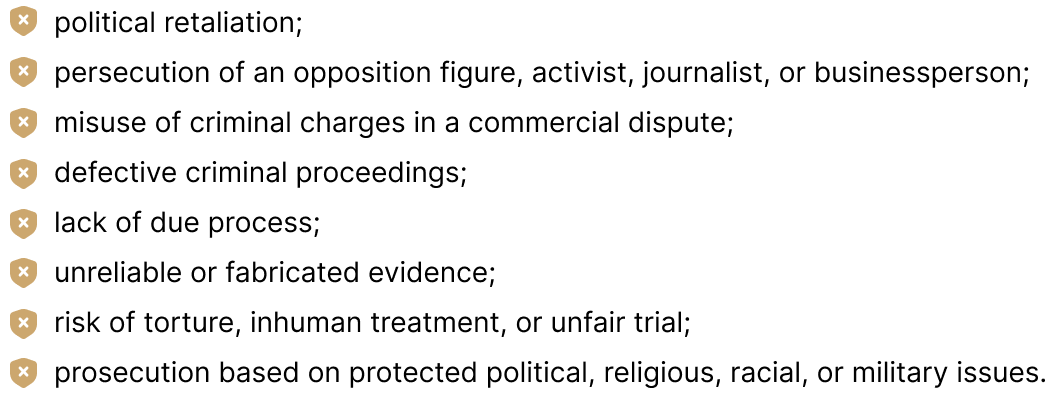
The goal is to place legal arguments and supporting evidence before INTERPOL before the foreign government succeeds in circulating damaging data through INTERPOL systems.
What Changed in 2026?
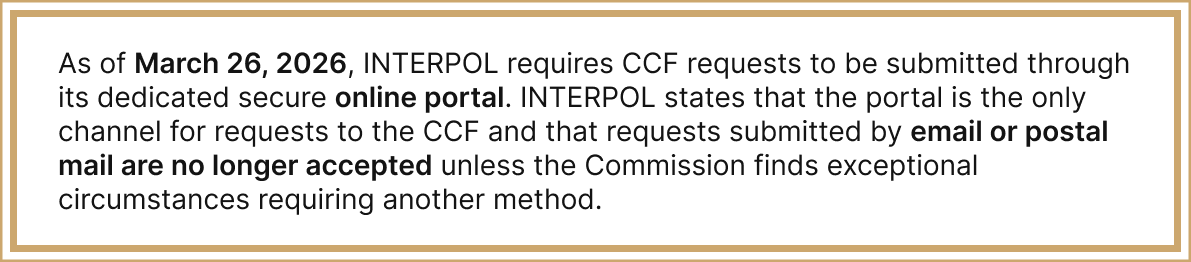
This is a major procedural change for anyone seeking to challenge or prevent an INTERPOL Red Notice, diffusion, or other data processing.
The new CCF portal expressly covers:
- access requests;
- correction and deletion requests; and
- revision requests.
However, the portal does not clearly list preemptive requests as a separate filing category. That creates a practical problem: individuals who are not yet the subject of known INTERPOL data may still face a credible risk that a foreign government will attempt to use INTERPOL against them.
Are INTERPOL Preemptive Requests Still Available?
The short answer is: yes, as a legal strategy, but not clearly as a separate formal portal category.
There is no public INTERPOL rule that expressly creates a standalone filing called a “preemptive request.” Instead, a preemptive request relies on INTERPOL’s broader legal framework, including:
- the INTERPOL Constitution;
- the Rules on the Processing of Data;
- the CCF’s authority over personal data;
- the General Secretariat’s compliance review;
- the Notices and Diffusions Task Force review process.
INTERPOL states that Notices and Diffusions must comply with the INTERPOL Constitution and the Rules on the Processing of Data. INTERPOL also explains that the CCF is the independent body responsible for ensuring that personal data processed through INTERPOL channels complies with INTERPOL’s rules.
Therefore, preventive advocacy remains possible. But because of the 2026 portal rules, it should now be framed carefully.
Best Current Strategy: Access Request Plus Preventive Memorandum
Under the 2026 CCF portal system, the strongest practical approach is usually to file an:

This title is important. It allows the filing to fit within the portal’s recognized access-request structure while also preserving the preventive purpose of the submission.
The request should ask the CCF to confirm whether INTERPOL holds any personal data concerning the applicant. At the same time, the applicant should attach a detailed legal memorandum explaining why any future request by the relevant country would be unlawful, abusive, politically motivated, inaccurate, or contrary to INTERPOL rules.
Legal Grounds for Opposing a Future Red Notice or Diffusion
A preventive INTERPOL submission should be based on specific legal grounds. The most common arguments include the following.
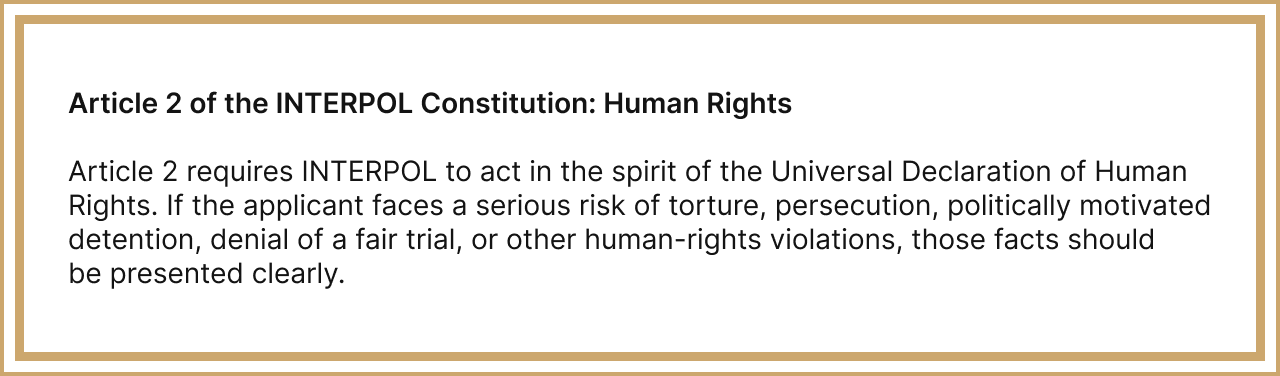
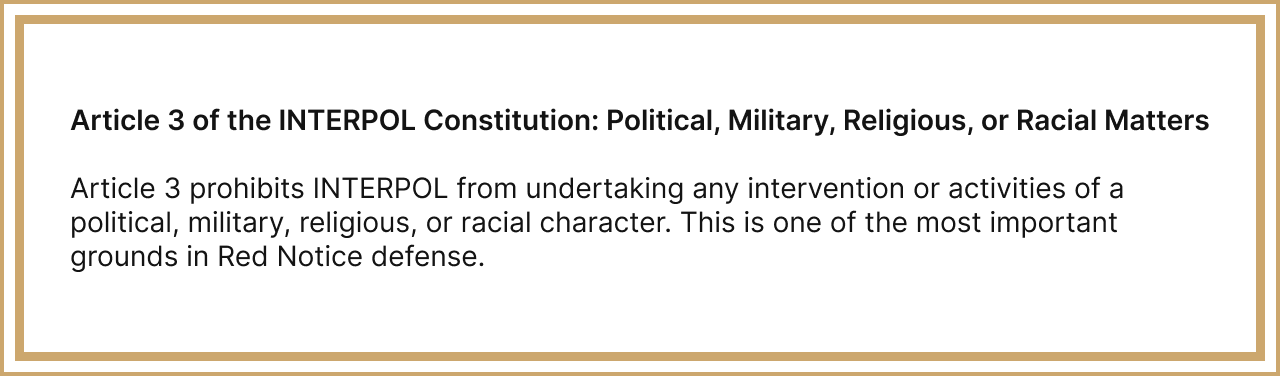
A preemptive request may argue that the foreign criminal case is political in substance, even if it is formally described as fraud, embezzlement, tax evasion, extremism, abuse of office, or another ordinary criminal offense.
Rules on the Processing of Data
INTERPOL’s Rules on the Processing of Data require that data processed through INTERPOL channels satisfy legal and quality standards. A preventive submission may argue that a future request would be:
- inaccurate;
- outdated;
- unsupported by sufficient evidence;
- disproportionate;
- based on a private or commercial dispute;
- inconsistent with due process;
- contrary to INTERPOL’s neutrality obligations.
Who Should Consider Filing an INTERPOL Preemptive Request?
A preemptive INTERPOL request may be appropriate for individuals who:
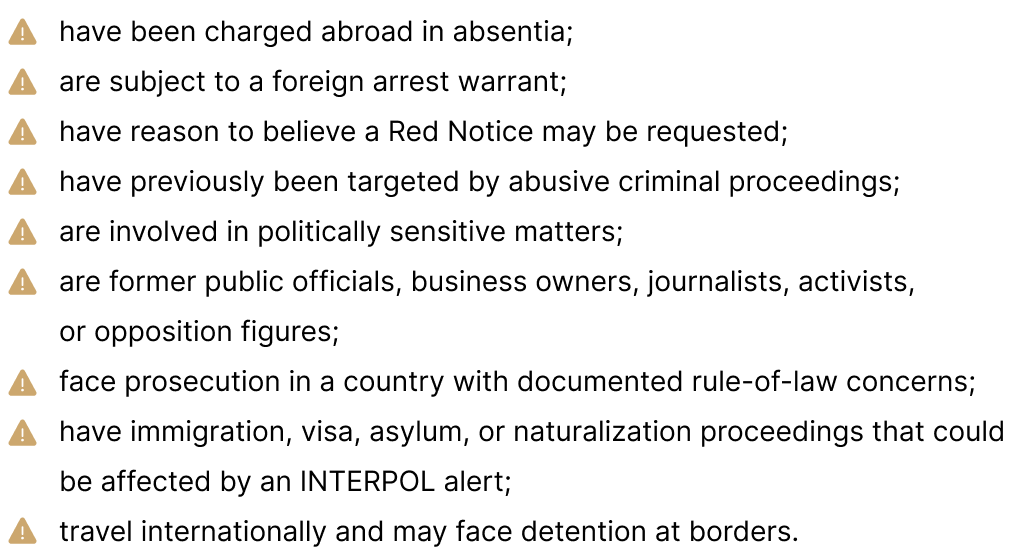
The earlier the strategy is developed, the better. Once a Red Notice or diffusion has already caused detention, visa refusal, banking problems, or immigration consequences, the case becomes more urgent and more difficult.
What Documents Should Be Included?
A strong INTERPOL preemptive submission should be organized and evidence-based. The package may include:
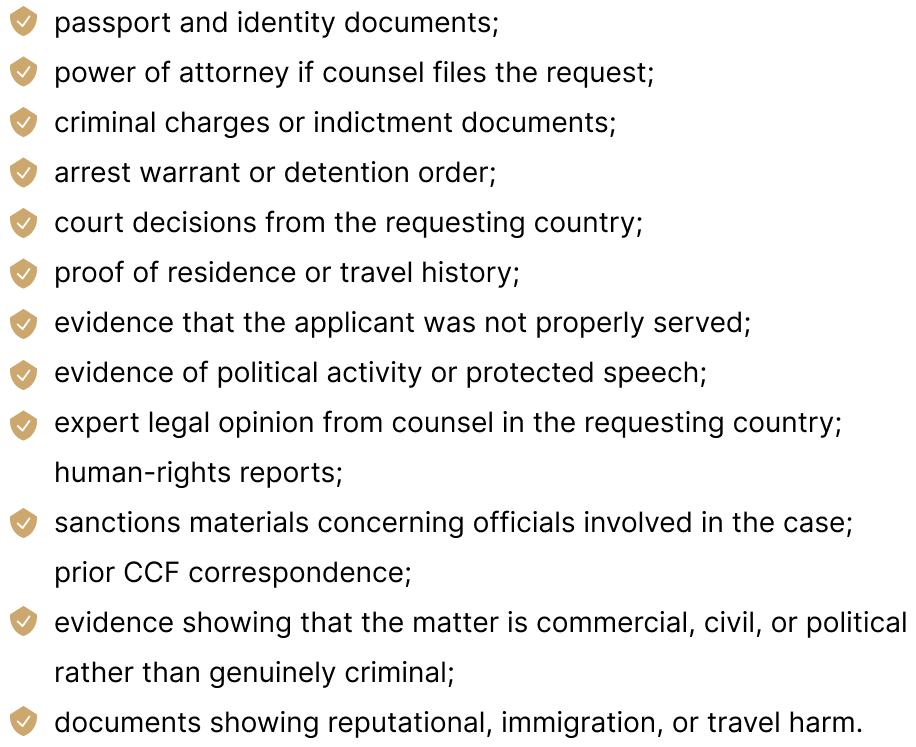
The materials should be submitted in a structured format, with a clear exhibit index. INTERPOL filings should not be overloaded with irrelevant documents. The strongest submissions are concise, factual, and supported by objective evidence.
How to Submit a Preemptive Request Under the 2026 CCF Portal Rules
Because ordinary email and postal submissions are no longer accepted absent exceptional circumstances, the applicant should generally proceed through the CCF Online Portal.
The practical filing steps are:
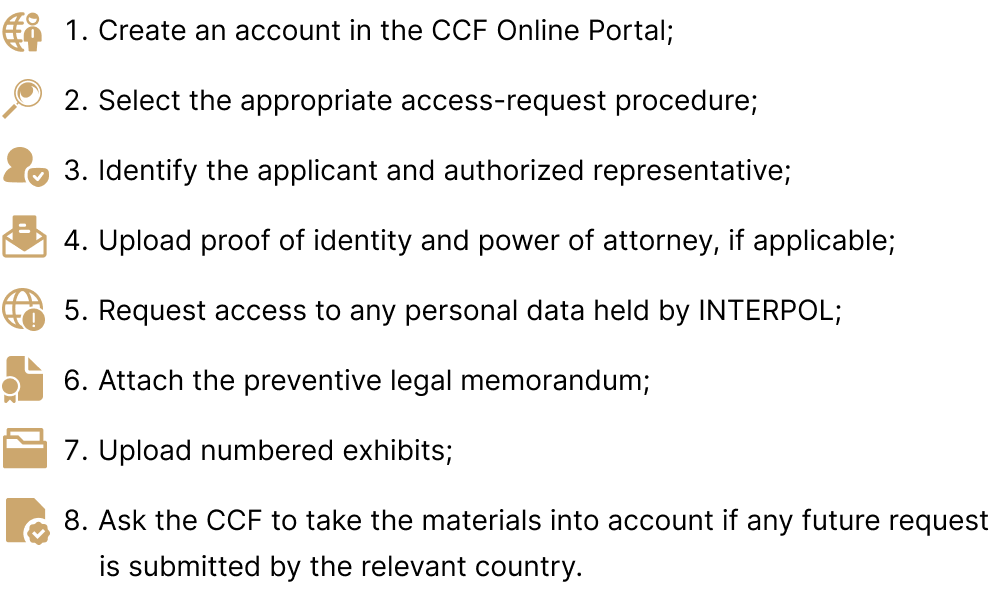
The request should make clear that, even if no data currently exists, the applicant is submitting the materials because there is a credible risk of future INTERPOL misuse.
Limitations of a Preemptive INTERPOL Request
A preemptive request is not a guarantee that no Red Notice or diffusion will ever be issued. Diffusions can be transmitted quickly, and in some cases review may occur after the information has already circulated.
A preventive filing also does not replace extradition counsel, immigration counsel, criminal-defense counsel, or emergency border-response planning.
However, a preemptive request can still be highly valuable. It creates a record before INTERPOL, preserves legal objections, and may help INTERPOL identify abuse earlier if the requesting country later attempts to circulate data.
Why the 2026 Rules Are Important for Red Notice Defense
The 2026 CCF portal rules make INTERPOL practice more formalized. For applicants, this creates both benefits and risks.
The benefits include a secure centralized filing system, clearer online submission process, and structured communication with the CCF.
The risks include reduced flexibility, uncertainty over preventive submissions, and the absence of a clearly labeled preemptive-request option. For high-risk individuals, this means that legal counsel must draft the request carefully so that it is accepted as an access request while also preserving the preventive objective.
Frequently Asked Questions About INTERPOL Preemptive Requests
What is an INTERPOL preemptive request?
An INTERPOL preemptive request is a preventive legal submission asking INTERPOL not to process any future Red Notice, diffusion, or other data concerning the applicant if the request would violate INTERPOL’s rules.
Can I file a preemptive request if there is no Red Notice yet?
Yes. If there is a credible risk that a foreign government may seek a Red Notice or diffusion, a preventive submission may be appropriate. Under the 2026 system, it should usually be filed as an access request with an attached preventive memorandum.
Does the 2026 CCF portal have a preemptive-request category?
The public portal framework does not clearly identify “preemptive request” as a separate category. This is why applicants should carefully frame the filing as an access request combined with a preventive submission.
Can I still file by email or mail?
Generally no. As of March 26, 2026, the CCF portal is the required channel for requests. Email or postal submissions are generally not accepted unless the CCF determines that exceptional circumstances justify another method.
Can a preemptive request stop a Red Notice?
It may help prevent, suspend, or later delete abusive INTERPOL data, but it is not an absolute guarantee. Its value is strongest when it is supported by clear evidence and submitted before the foreign government’s request is processed.
What is the difference between a Red Notice and a diffusion?
A Red Notice is a request to locate and provisionally arrest a person pending extradition or similar legal action. A diffusion is also an INTERPOL communication but is circulated more directly by a member country to selected countries or the entire INTERPOL network. Both can create serious travel, immigration, and enforcement consequences.
Do I need an INTERPOL lawyer?
A lawyer is not formally required in every case, but legal representation is strongly advisable where the case involves political motivation, extradition risk, immigration consequences, sanctions issues, or a foreign arrest warrant.
INTERPOL Preemptive Requests After the 2026 Portal Reform
INTERPOL preemptive requests remain an important tool in Red Notice defense and diffusion prevention. However, the 2026 CCF portal reform has changed the way these requests should be submitted.
Because the portal does not clearly provide a separate preemptive-request category, applicants should usually file an access request and attach a preventive legal memorandum. The memorandum should explain why any future request from the relevant country would violate the INTERPOL Constitution, the Rules on the Processing of Data, and fundamental human-rights protections.
For individuals facing politically motivated prosecution, abusive foreign charges, or possible misuse of INTERPOL channels, early preventive action may be critical. A properly prepared submission can help protect international travel, immigration status, reputation, and liberty before a Red Notice or diffusion causes serious harm.
The key factual points are supported by INTERPOL’s own materials: the CCF portal became the required channel for requests as of March 26, 2026, with email/postal filing generally no longer accepted absent exceptional circumstances; INTERPOL states that Notices and Diffusions must comply with the Constitution and Rules on the Processing of Data; and the CCF is the independent body responsible for ensuring that personal data processed through INTERPOL channels conforms to INTERPOL’s rules.