
 ES
ES  RU
RU  TR
TR  FA
FA  AR
AR  ZH
ZH Blog
Blog description

Interpol Red Notices and Extradition: What Happens After an International Alert
An INTERPOL Red Notice is one of the most powerful and most frequently misunderstood tools in international law enforcement cooperation. It is often described in the media as an “international arrest warrant,” but that characterization is not accurate. A Red Notice is not a warrant and, by itself, does not automatically authorize an arrest in most jurisdictions.
In practical terms, a Red Notice is a request circulated through the INTERPOL network asking law enforcement authorities worldwide to locate and provisionally arrest an individual, pending extradition or similar legal proceedings.
What happens next is not automatic. It depends on a combination of legal and practical factors, including:
- the domestic law of the country where the individual is located
- whether an extradition treaty exists between the relevant countries
- the nature of the alleged offense
- the level of judicial safeguards in the requested state
- the availability of legal defenses, including political-offense protections
For executives, investors, international professionals, and individuals facing cross-border exposure, understanding how INTERPOL alerts interact with extradition law is not just helpful, it is essential to assessing real-world risk.
What Is an Interpol Red Notice?
A Red Notice is a global law enforcement alert issued through the INTERPOL network at the request of a member country.
Its core purpose is to:
- identify and help locate a wanted individual
- notify police authorities across INTERPOL’s 195 member countries
- request provisional arrest, pending extradition or similar legal action
At the same time, a Red Notice comes with important legal limitations: particularly when it comes to how (and whether) it can be enforced in a given jurisdiction.
A Red Notice Is Not:
- an international arrest warrant
- a judicial determination of guilt
- automatically enforceable in every country
Each country decides independently whether and how to act upon a Red Notice under its own domestic legal system.
Some jurisdictions treat Red Notices as sufficient grounds for detention, while others require a separate judicial arrest warrant before authorities may detain an individual.
How Interpol Issues a Red Notice
A Red Notice is not issued automatically. A member country must first submit a request supported by a domestic judicial decision, typically an arrest warrant or court order.
Before circulating the notice, INTERPOL conducts an internal review to check compliance with its core legal framework, including:
- the INTERPOL Constitution
- the Rules on the Processing of Data (RPD)
- Article 3 of the Constitution, which prohibits involvement in matters of a political, military, religious, or racial character
This review, however, is administrative, not judicial. It is designed to screen for compliance with INTERPOL’s rules, not to adjudicate the merits of the underlying case.
As a result, controversial or disputed cases can still enter the INTERPOL system, even where there are credible concerns about the legitimacy or motivation of the underlying criminal proceedings.
What Happens Immediately After a Red Notice Is Issued
Once published, the Red Notice is distributed across the global Interpol network and becomes visible to:
- national police agencies
- border authorities
- immigration officials
- specialized investigative units
The consequences may include:
- airport detention or questioning
- travel restrictions
- border alerts
- immigration scrutiny
- enhanced law-enforcement monitoring
In certain jurisdictions, authorities may initiate provisional arrest proceedings.
Provisional Arrest: The First Step Toward Extradition
If authorities decide to act on the Red Notice, they may detain the individual under domestic law through a process known as provisional arrest.
Provisional arrest is intended to give the requesting country time to submit a formal extradition request.
The typical sequence is:
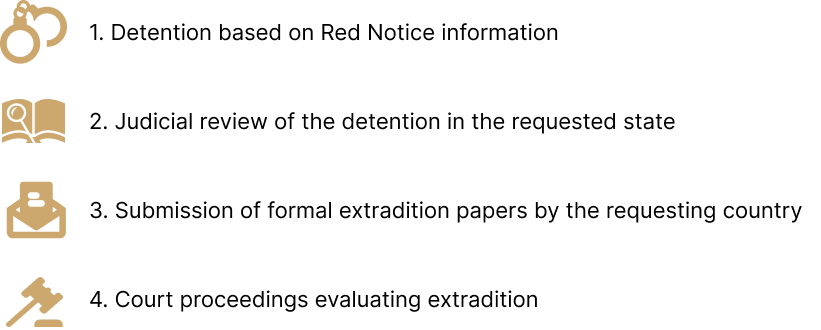
Most extradition treaties impose strict deadlines: often 30 to 60 days for the requesting country to submit the formal extradition package.
If the requesting state fails to meet this deadline, the detained individual may be released.
Extradition Is Governed by Treaties — Not Interpol
Interpol itself does not conduct extradition.
Extradition occurs only if there is a legal basis between the two countries involved.
This legal basis usually takes one of the following forms:
- a bilateral extradition treaty
- a multilateral convention
- domestic extradition legislation
If no such framework exists, extradition may not be legally possible even if a Red Notice is active.
Legal Requirements Courts Evaluate in Extradition Cases
Courts in the requested country evaluate several legal standards before approving extradition.
Dual Criminality
The alleged conduct must constitute a crime in both jurisdictions.
For example, financial fraud or embezzlement typically satisfies this requirement because such offenses exist in most legal systems.
Evidentiary Threshold
Many jurisdictions require evidence equivalent to probable cause.
Courts may evaluate:
- arrest warrants
- charging documents
- witness statements
- summaries of investigative evidence
However, the requested court generally does not conduct a full criminal trial.
Specialty Principle
Under the specialty rule, the requesting country may prosecute the extradited individual only for the offenses specified in the extradition request.
Additional charges usually require the consent of the requested state.
Political Offense Exception
Most extradition treaties prohibit extradition for political offenses.
This safeguard protects individuals from prosecution arising from:
- political opposition activities
- geopolitical conflicts
- politically motivated prosecutions
This exception is particularly significant in cases involving alleged economic crimes intertwined with political disputes.
Countries That Frequently Act on Red Notices
The likelihood of arrest varies widely depending on jurisdiction.
Countries often considered high-risk locations for detention based on Red Notices include:
🇪🇸 Spain
🇩🇪 Germany
🇮🇹 Italy
🇹🇷 Turkey
🇦🇪 United Arab Emirates
In contrast, some jurisdictions require additional judicial authorization before arrest.
How the United States Treats Interpol Red Notices
In the United States, a Red Notice does not automatically authorize arrest.
U.S. authorities must obtain either:
- a domestic arrest warrant issued by a U.S. court, or
- a provisional arrest request pursuant to an extradition treaty
As a result, the existence of a Red Notice alone is generally insufficient to detain someone within U.S. territory.
Nevertheless, Red Notices can still produce significant consequences in the United States, including:
- immigration complications
- visa revocation
- enhanced screening by federal agencies
- travel restrictions
Challenging an Interpol Red Notice
Individuals can challenge an INTERPOL notice through the Commission for the Control of INTERPOL’s Files (CCF), an independent body responsible for overseeing how data is processed within INTERPOL systems.
In practice, the CCF reviews whether a notice complies with INTERPOL’s rules and governing principles. Common grounds for requesting removal include:
- evidence of political motivation
- absence of a valid underlying judicial decision
- violations of INTERPOL’s own rules
- human rights concerns
- lack of proportionality
If the CCF concludes that a notice does not meet INTERPOL’s requirements, it has the authority to order the deletion of the data from INTERPOL systems worldwide.
Strategic Legal Responses After a Red Notice
Individuals facing an Interpol Red Notice often pursue several parallel legal strategies.
Interpol Challenge
Submitting a detailed legal application to the CCF requesting deletion of the notice.
Extradition Defense
Challenging extradition based on:
- lack of dual criminality
- insufficient evidence
- treaty limitations
Human Rights Protection
Arguing that extradition would expose the individual to:
- unfair trial
- political persecution
- inhumane detention conditions
Immigration Protection
In certain cases, individuals may seek:
- asylum
- refugee protection
- humanitarian relief
Conclusion
A Red Notice is not the end of the legal process: it is often the starting point of a complex, multi-jurisdictional dispute.
Whether it ultimately leads to detention or extradition depends on how several legal layers interact, including:
- INTERPOL procedures
- domestic criminal law in the country where the individual is located
- applicable extradition treaties
- human rights protections and judicial safeguards
For individuals facing cross-border exposure, timing matters. An early, well-structured legal strategy can be decisive in preventing detention, challenging INTERPOL alerts, and building a defense against potential extradition proceedings.