
 ES
ES  RU
RU  TR
TR  FA
FA  AR
AR  ZH
ZH Blog
Blog description

Does an OFAC Sanctions Alert Trigger a Suspicious Activity Report (SAR)?
A bank flags an international transaction because of a potential OFAC sanctions issue. The payment is delayed, rejected, or blocked. The bank's compliance department begins asking questions about the parties, source of funds, beneficial ownership, invoices, or purpose of the transaction.
A natural question follows:
Did the bank also file a Suspicious Activity Report (SAR)?
The answer is more nuanced than many customers expect.
An OFAC sanctions alert does not automatically mean that a financial institution filed a separate SAR. OFAC reporting and SAR reporting arise under different regulatory regimes and serve different purposes. However, when the facts surrounding a sanctions alert independently appear suspicious, such as possible sanctions evasion, use of front companies or proxies, misleading payment information, unexplained intermediaries, or a sham transaction, the financial institution may have separate obligations under the Bank Secrecy Act (BSA) and applicable FinCEN regulations.
For businesses and individuals involved in cross-border transactions, understanding this distinction is increasingly important. OFAC's March 2026 guidance on sham transactions and sanctions evasion further highlights why banks may look beyond the names appearing on a payment instruction and examine the economic reality of a transaction.
OFAC Reporting and SAR Reporting Are Not the Same Thing
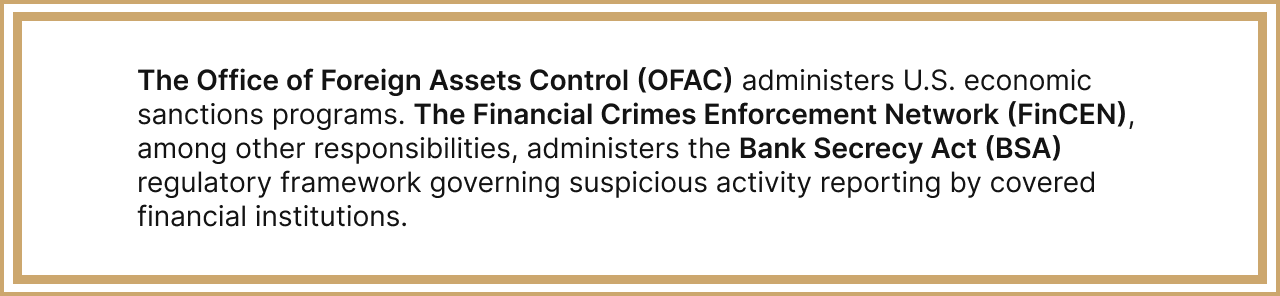
These regimes frequently intersect, but they should not be confused.
An OFAC blocking or rejecting report generally concerns property or transactions subject to applicable sanctions reporting requirements.
A Suspicious Activity Report (SAR), by contrast, is designed to report activity meeting applicable suspicious-activity reporting criteria under the BSA and FinCEN regulations.
The principal differences can be summarized as follows:
|
Issue |
OFAC Blocking/Reject Report |
Suspicious Activity Report (SAR) |
|
Primary regulator |
U.S. Treasury – OFAC |
U.S. Treasury – FinCEN |
|
Regulatory framework |
U.S. economic sanctions regulations |
Bank Secrecy Act / AML regulations |
|
Primary purpose |
Report blocked property or rejected transactions required by sanctions rules |
Report activity meeting applicable suspicious-activity criteria |
|
Typical trigger |
Transaction or property implicates an OFAC prohibition |
Institution identifies potentially suspicious activity under applicable BSA/SAR rules |
|
Does it establish wrongdoing? |
No |
No |
|
Can the customer generally know about it? |
Often, particularly where funds have been blocked or a transaction rejected |
Generally no; SARs are subject to strict confidentiality requirements |
|
Can both apply to the same transaction? |
Yes |
Yes |
|
Can an OFAC report sometimes satisfy SAR requirements? |
In certain circumstances involving specified OFAC matches, FinCEN permits an OFAC blocking report to satisfy the SAR requirement arising from the match |
A separate SAR may still be required where independently suspicious activity or relevant additional information exists |
The critical point is that the same transaction can implicate both regulatory systems, but for different reasons.
A transaction can therefore create an OFAC issue without necessarily creating an independently reportable SAR issue. Conversely, conduct intended to circumvent sanctions may present suspicious activity concerns even where a transaction was never successfully completed.
Does an OFAC Match Automatically Require a Separate SAR?
Not necessarily.
This is where an important, and sometimes overlooked, FinCEN interpretation becomes relevant.
FinCEN has issued guidance designed to avoid duplicative reporting for certain verified OFAC matches. Under that guidance, when a financial institution files an OFAC blocking report involving certain categories of OFAC-designated persons, the OFAC report may be deemed to satisfy the SAR requirement arising from the fact of that match.
But there is a critical limitation.
If the surrounding transaction would independently be reportable as suspicious even without the OFAC match, the OFAC blocking report does not necessarily satisfy the institution's SAR reporting obligation.
Likewise, FinCEN's guidance states that if the institution possesses relevant information that was not included in the OFAC blocking report, a separate SAR should be filed containing that additional information.
In practical terms, the compliance analysis can involve two separate questions:
Question 1: Is there an OFAC sanctions issue?
and
Question 2: Is there independently suspicious activity surrounding the transaction?
Those questions can produce different answers.
What Could Make a Sanctions-Related Transaction Independently Suspicious?
Consider a straightforward false-positive sanctions alert.
A company sends a legitimate payment to an unrelated counterparty whose name happens to resemble the name of an SDN. The bank's screening software generates an alert, the institution investigates it, and the match is cleared.
That is fundamentally different from a transaction in which the bank discovers that:
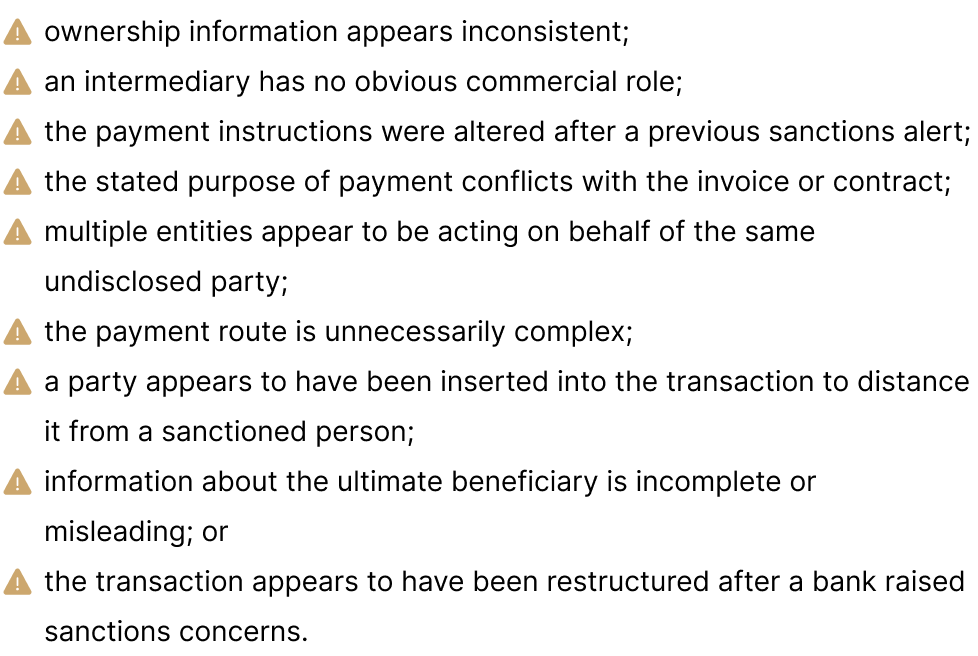
These circumstances do not establish wrongdoing by themselves. International transactions can have legitimate reasons for involving multiple entities, banks, jurisdictions, or payment routes.
But they may cause a financial institution to investigate whether something more than a technical sanctions match is occurring.
OFAC's 2026 Guidance on “Sham Transactions”
This issue became particularly significant in 2026.
On March 31, 2026, OFAC published Guidance on Sham Transactions and Sanctions Evasion, emphasizing that sanctions analysis does not necessarily end with the formal legal structure of a transaction.
OFAC describes sham transactions as arrangements in which blocked persons, often acting through proxies or intermediaries, purportedly transfer property or establish arrangements that conceal rather than genuinely eliminate their continuing interest in the property.
The practical lesson is significant:

For banks and other financial institutions, this increases the importance of understanding not merely who appears on the payment instruction, but also who actually owns, controls, benefits from, or retains an economic interest in the transaction.
A Transaction Does Not Have to Say “Sanctioned Person” to Create Sanctions-Evasion Concerns
Sophisticated sanctions screening is not limited to comparing names against the SDN List.
Financial institutions may examine:
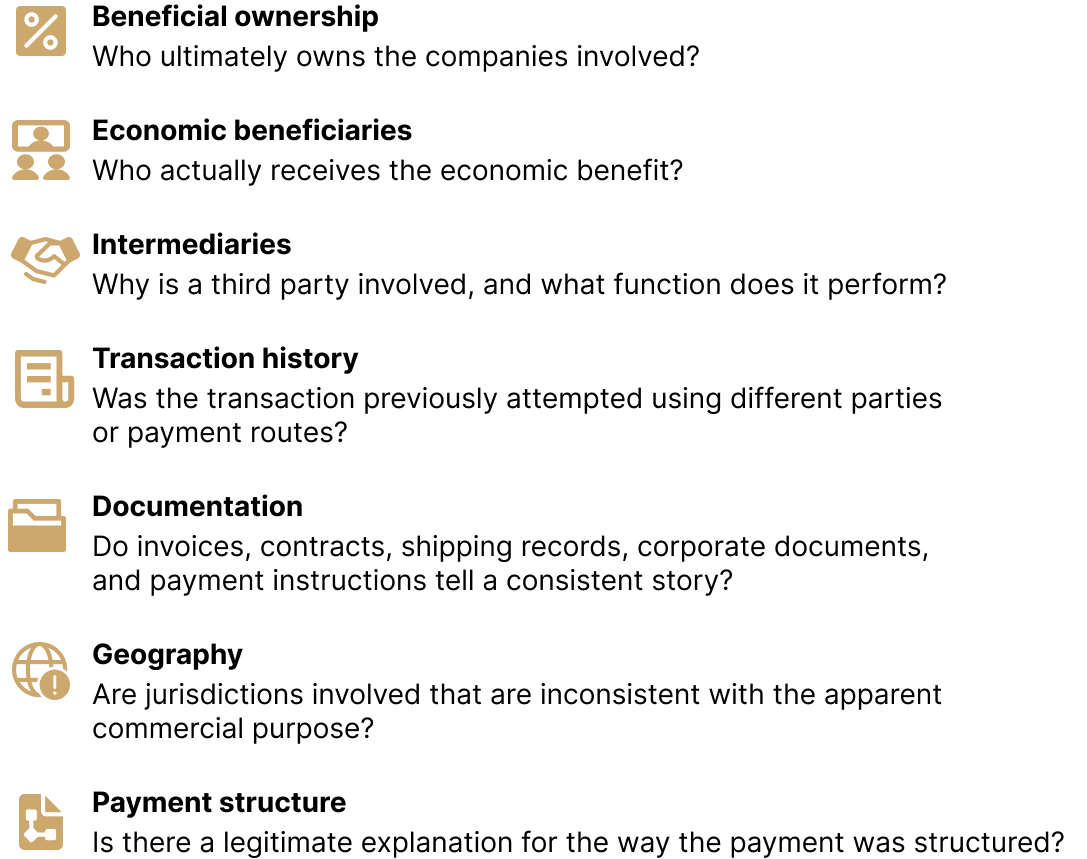
This is one reason a transaction may receive heightened scrutiny even though neither the sender nor the named beneficiary appears on an OFAC sanctions list.
Why Re-Routing a Transaction After an OFAC Alert Can Be Dangerous
Suppose Bank A refuses to process a transaction because of a sanctions concern.
The parties then modify the payment instructions and attempt the same underlying transaction through Bank B.
That does not necessarily constitute sanctions evasion. The original bank may have been wrong, a false positive may have occurred, or another lawful explanation may exist.
But attempting to bypass the original compliance problem without first understanding why the transaction was stopped can materially complicate the situation.
If the revised transaction removes a party, changes the payment description, substitutes an intermediary, or restructures the payment in a way that appears designed to prevent sanctions screening from identifying the original issue, the compliance implications may become considerably more serious.
The better approach is usually to determine the legal basis for the original sanctions concern before restructuring or resubmitting the transaction.
Can the Bank Tell You Whether It Filed a SAR?
No.
This is one of the most important practical rules for customers dealing with a bank compliance investigation.

This produces a situation that can be frustrating for customers.
A bank might tell you that:
- the transaction is under compliance review;
- additional information is required;
- the bank cannot process the transaction;
- the payment has been blocked;
- the payment was rejected; or
- the account relationship is being reviewed.
But the institution cannot simply tell you:
“We filed a SAR concerning this transaction.”
Therefore, a bank's refusal to answer questions about a SAR should not itself be interpreted as evidence that a SAR exists.
Can You Demand a Copy of a SAR?
A customer cannot require the bank to provide the SAR merely because the report allegedly concerns the customer's transaction.
FinCEN has repeatedly emphasized SAR confidentiality, including in the context of private litigation. Financial institutions, as well as their directors, officers, employees, agents, and contractors, are prohibited from disclosing a SAR or information that would reveal its existence.
There is, however, an important distinction between a SAR itself and the underlying business records.
Invoices, wire instructions, account records, correspondence, contracts, and other documents do not automatically become confidential SAR material merely because they may have been considered in connection with a SAR.
That distinction can become significant in litigation, investigations, subpoenas, and other proceedings.
Does a SAR Mean the Government Has Opened a Criminal Investigation?
No.
A SAR is a regulatory report of suspicious activity. It is not, by itself, a criminal charge, indictment, finding of liability, or determination that the customer violated sanctions law.
Financial institutions file SARs so that potentially relevant financial intelligence is available to appropriate government authorities.
A person therefore should not assume that the possible existence of a SAR means that OFAC, FinCEN, the Department of Justice, or another agency has concluded that a violation occurred.
At the same time, a SAR can provide information to law-enforcement and regulatory authorities. That is why businesses should take sanctions-related compliance inquiries seriously, particularly where the transaction involves unusual intermediaries, ownership structures, sanctioned jurisdictions, or possible attempts to circumvent an earlier bank restriction.
Can a Bank File a SAR Even If No OFAC Violation Ultimately Occurred?
Potentially, yes.
The two analyses are different.
Imagine that a bank investigates an OFAC alert and ultimately determines that the transaction does not involve blocked property.
During the investigation, however, the institution discovers other facts that it considers independently suspicious under the applicable BSA rules.
The absence of an ultimate OFAC violation does not necessarily resolve those separate concerns.
This is another reason why “we are not on the SDN List” is not always a complete answer to a bank's compliance inquiry.
What Happens If OFAC Authorizes the Transaction?
Obtaining an OFAC license or other applicable authorization can be critical where sanctions regulations prohibit the transaction.
But an OFAC authorization should not necessarily be understood as an instruction requiring every financial institution to process the transaction.
A bank may have separate obligations involving AML, fraud prevention, customer due diligence, sanctions compliance, and other regulatory requirements. It may also operate under its own risk-management policies.
Therefore:

This distinction can explain why a customer may obtain an OFAC authorization yet still face questions from the financial institution before the transaction is processed.
What Should You Do When a Bank Starts Asking Sanctions and AML Questions?
The first priority should generally be understanding exactly what the institution is concerned about.
Do not assume that every compliance inquiry is merely a false-positive name match.
Depending on the transaction, relevant documentation may include:
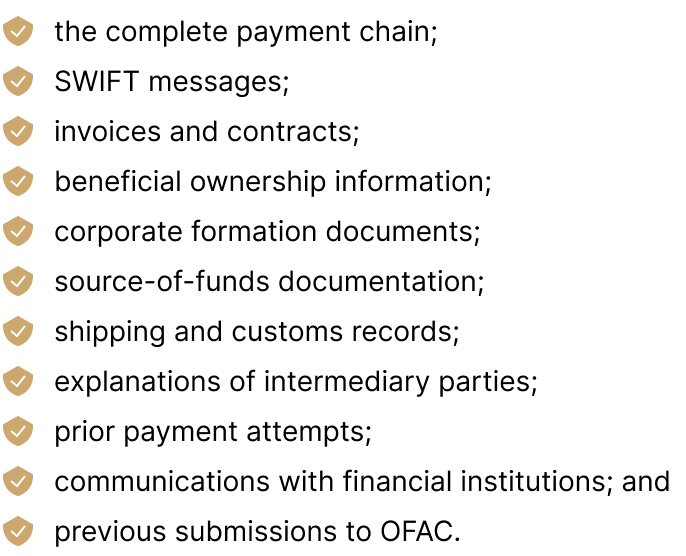
The objective should be to develop a consistent factual record explaining the legitimate economic purpose of the transaction and the role of each material participant.
Consistency Matters
One of the most avoidable problems in sanctions matters is inconsistent information.
For example, a customer tells one bank that a payment concerns consulting services, while an invoice describes equipment. Another document identifies a different purchaser. Corporate records show an owner not disclosed in the original compliance response.
There may be perfectly legitimate explanations for each discrepancy.
But unexplained inconsistencies can create additional compliance questions.
Before responding to a bank, OFAC, or another regulator, businesses should therefore reconstruct the transaction carefully and make sure the documentary record accurately reflects what occurred.
This is especially important when several financial institutions are involved because information submitted to one institution may later be compared with information available elsewhere.
OFAC, FinCEN, and the Modern Sanctions-Evasion Investigation
The intersection between sanctions compliance and AML controls has become increasingly important.
FinCEN has issued multiple advisories and alerts identifying financial typologies associated with sanctions evasion. In May 2026, for example, FinCEN issued an alert concerning the use of front companies, financial facilitators, and digital-asset infrastructure to evade Iran-related sanctions and launder proceeds.
Together with OFAC's 2026 sham-transaction guidance, the regulatory direction is clear:
U.S. authorities increasingly expect financial institutions to look beyond formal documentation and evaluate the actual economic substance of transactions.
For legitimate businesses, this makes transparency, accurate beneficial-ownership information, and consistent transaction documentation increasingly important.
Frequently Asked Questions
Does every OFAC-blocked transaction result in a SAR?
No. An OFAC blocking report and a SAR are different regulatory reports. FinCEN has special guidance under which certain OFAC blocking reports may satisfy SAR requirements arising from specified OFAC matches, while independently suspicious circumstances can create separate SAR obligations.
Does an OFAC sanctions alert mean I am under investigation?
No. A sanctions-screening alert may arise for many reasons, including a potential name match. An alert alone does not establish that a sanctions violation occurred or that a government investigation exists.
Will my bank tell me whether it filed a SAR?
No. SARs and information that would reveal their existence are subject to strict confidentiality rules.
Can I obtain a copy of a SAR about myself or my company?
The financial institution cannot disclose a SAR to the person involved in the reported transaction. The underlying transactional records, however, are not automatically transformed into confidential SAR material merely because they may support a SAR.
Can a bank file a SAR even if the transaction did not violate OFAC sanctions?
Yes, potentially. A bank may determine that there is no sanctions violation but identify other activity that independently meets applicable suspicious-activity reporting criteria.
If OFAC grants a specific license, does the bank have to process the payment?
Not necessarily. An OFAC authorization addresses applicable sanctions restrictions, but a financial institution may have independent AML, fraud, regulatory, or risk-management concerns.
Should I send a rejected payment through another bank?
Not without first understanding why the original transaction was stopped. A legitimate alternative payment route may be permissible, but restructuring a transaction in a manner that appears intended to conceal a sanctions nexus can create substantially greater compliance concerns.
What is an OFAC sham transaction?
Under OFAC's March 2026 guidance, the concept generally concerns arrangements in which a blocked person ostensibly transfers or gives up an interest in property while, in economic reality, continuing to retain that interest through proxies, intermediaries, or other arrangements.
Key Takeaways
An OFAC sanctions alert and a Suspicious Activity Report are not the same thing.
A transaction can generate an OFAC reporting obligation, a SAR obligation, both, or in some circumstances neither.
FinCEN has specifically recognized circumstances in which an OFAC blocking report can satisfy the SAR requirement associated with certain OFAC matches. But that does not eliminate the obligation to report independently suspicious activity where applicable.
Customers will not know whether a SAR has been filed because federal law imposes strict SAR confidentiality requirements.
Most importantly, modern sanctions compliance increasingly focuses on economic substance rather than formal appearance. OFAC's 2026 sham-transaction guidance underscores the risks associated with proxies, intermediaries, artificial transfers, and arrangements that conceal a blocked person's continuing economic interest.
For businesses engaged in cross-border transactions, the practical lesson is straightforward:
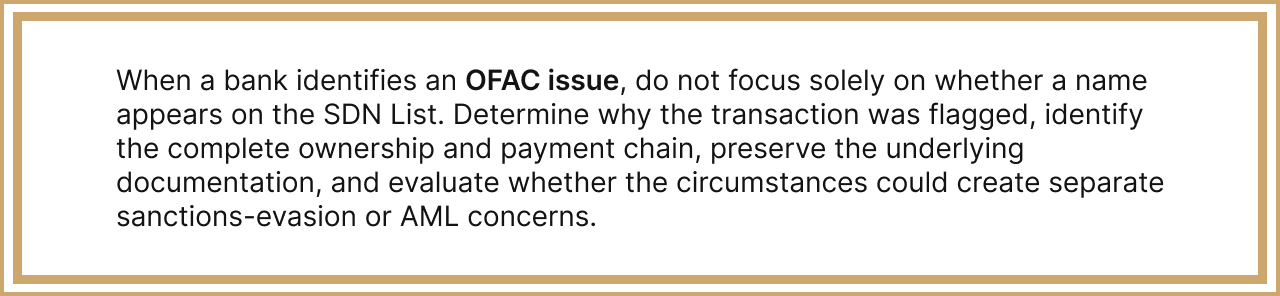
Understanding that distinction early can prevent a routine sanctions-screening issue from becoming a significantly more complicated compliance problem.