
 ES
ES  RU
RU  TR
TR  FA
FA  AR
AR  ZH
ZH Blog
Blog description

OFAC SDN List Removal: 2026 Guide to Delisting Petitions and the New Reconsideration Portal
On June 29, 2026, the U.S. Department of the Treasury’s Office of Foreign Assets Control, commonly known as OFAC, launched the new OFAC Reconsideration Portal for persons, entities, and listed property seeking removal from OFAC sanctions lists, including the Specially Designated Nationals and Blocked Persons List, commonly known as the SDN List. OFAC also updated FAQ 897, issued new FAQ 1261, and published new quick-reference guidance on delisting petitions.
This 2026 update is significant because it gives sanctioned persons, companies, vessel owners, aircraft owners, and their legal representatives a more structured process for submitting an OFAC delisting petition, also called an SDN removal petition, request for reconsideration, or petition for removal from an OFAC sanctions list.
For sanctioned parties, the change means that a successful OFAC petition must be carefully prepared from the beginning. A weak, incomplete, or poorly organized filing may lead to delays, additional questionnaires, or denial.
What Is an OFAC Delisting Petition?

The most serious and widely known OFAC list is the SDN List. Once a person or entity is placed on the SDN List, U.S. persons are generally prohibited from dealing with that person or entity, and property or interests in property subject to U.S. jurisdiction are generally blocked.
OFAC’s administrative reconsideration process allows a listed person, listed entity, owner of listed property, or authorized representative to ask OFAC to reconsider whether the sanctions designation should remain in effect. OFAC reviews delisting petitions under 31 C.F.R. § 501.807.
Why the June 29, 2026 OFAC Update Matters
The June 29, 2026 update is more than a website change. OFAC launched the Reconsideration Portal to streamline the delisting process and help petitioners provide required information at the beginning of the case. OFAC also stated that it strongly encourages use of the portal and is transitioning away from email submission in the future.
This matters because OFAC delisting cases are document-heavy and fact-sensitive. A petitioner must identify the exact sanctions authority, designation criteria, factual basis for listing, and legal grounds for removal.
In practical terms, the new process makes early case preparation more important. Counsel should not treat the portal as a simple online form. The submission should be supported by legal analysis, evidence, exhibits, translations, and a clear explanation of why the designation should be removed.
Who Can Submit an SDN List Removal Petition?
The OFAC administrative reconsideration process is intended for persons, entities, or property that actually appear on an OFAC sanctions list or are otherwise sanctioned.
A petition may be submitted by:
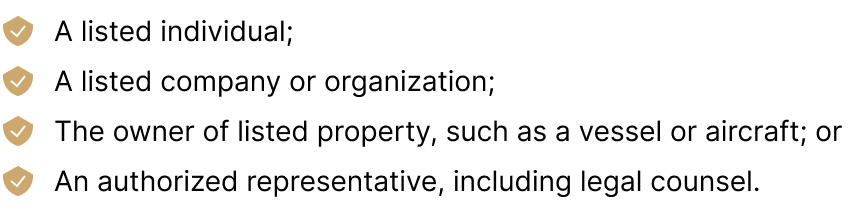
If the matter involves only a false name match, mistaken screening result, or compliance screening issue, OFAC directs the person to contact OFAC’s Compliance Hotline rather than submit a delisting petition.
If an attorney or other representative files the petition, OFAC generally requires proof of authorization, such as a power of attorney, together with information describing the representative’s relationship to the listed person or property.
Requesting a Courtesy Document Before Filing
One important feature of the updated process is the ability to request a courtesy document through the OFAC Reconsideration Portal.

This can be strategically important. An effective delisting petition should respond to OFAC’s actual designation basis, not merely to the petitioner’s assumptions. In complex SDN removal cases, counsel may first request a courtesy document, review the available basis for designation, and then prepare a targeted petition addressing each relevant designation criterion.
Required Information for an OFAC Delisting Petition
A strong OFAC delisting petition should clearly identify the sanctioned person, entity, or property and provide supporting documentation.
At a minimum, the petitioner should usually include:
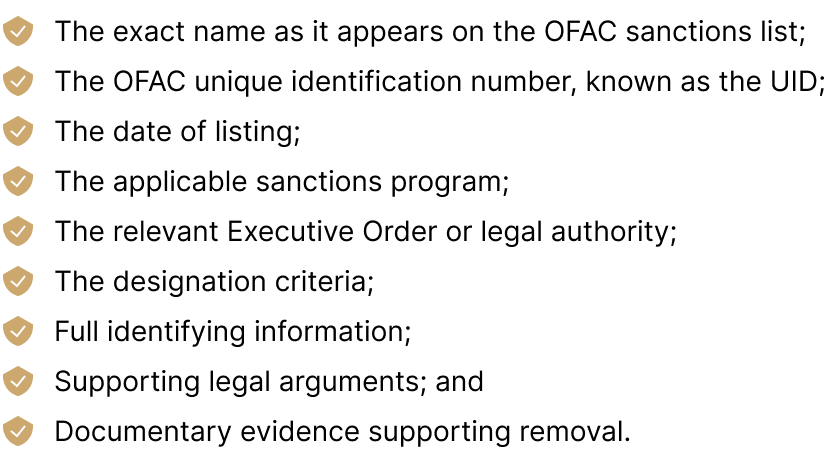
For individuals, OFAC may require or expect identifying information such as full legal name, aliases, date and place of birth, proof of identity, physical address, mailing address, email address, and telephone number.
For entities or listed property, OFAC may require or expect corporate registration documents, official registered names, aliases, ownership information, registration dates, addresses, websites, contact information, and documents showing ownership, control, or operational status.
Additional evidence may include employment history, source of income, corporate ownership charts, bank account information, virtual currency information, real property records, social media handles, websites, business relationships, and information regarding connections to other sanctioned persons or entities.
Main Legal Grounds for SDN Removal
OFAC generally recognizes two main grounds for removal from an OFAC sanctions list: change in circumstances and insufficient basis.
1. Change in Circumstances
A change in circumstances argument asserts that the facts supporting the designation have changed after the sanctions listing.
Examples may include:
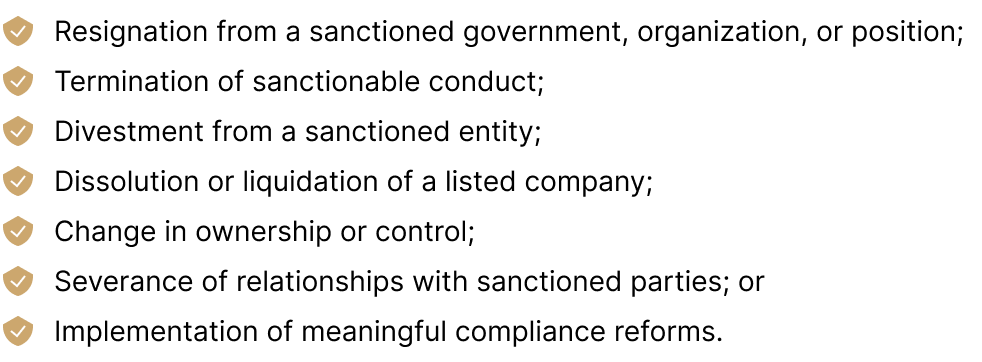
This argument is often used when the original designation may have been justified at the time, but the factual basis no longer exists.
However, petitioners must be careful. Asset transfers, restructurings, or divestments involving blocked property may themselves require OFAC authorization. Sham transfers or transfers to other blocked persons may create additional sanctions risk.
2. Insufficient Basis
An insufficient basis argument asserts that OFAC lacked a proper basis for the designation when it was imposed.
Examples may include:
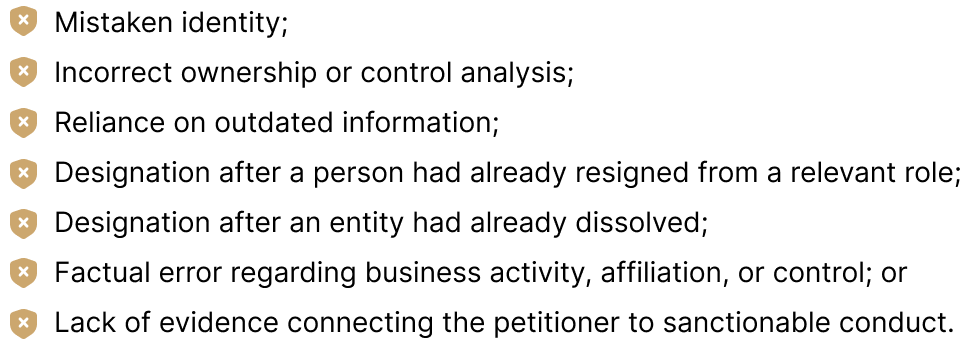
This argument is different from change in circumstances. In an insufficient-basis petition, the focus is on whether the designation was incorrect or unsupported at the time it was made.
Multiple Sanctions Authorities Must Be Addressed
A common mistake in OFAC delisting petitions is addressing only one basis for designation while ignoring another.
If a person or entity is listed under multiple Executive Orders, sanctions programs, or designation criteria, the petition should address each independent basis for listing. A petitioner may present a strong argument under one authority but still remain listed if another basis remains unaddressed.
For this reason, counsel should carefully review the SDN List entry, OFAC press releases, sanctions program tags, Executive Orders, Federal Register notices, and any courtesy document or available administrative record before preparing the petition.
Old vs. New OFAC Delisting Process: Practical Comparison
|
Issue |
Prior Practice |
2026 Updated Practice |
|
Submission method |
Often submitted by email or written correspondence |
OFAC strongly encourages use of the Reconsideration Portal |
|
Initial filing |
Less structured format |
More structured portal-guided submission |
|
Required information |
Often developed through follow-up questionnaires |
Greater emphasis on providing complete information upfront |
|
Courtesy document request |
Available but less centralized |
Can be requested through the Reconsideration Portal |
|
Refiling after denial |
Possible, but less clearly highlighted in public guidance |
FAQ 1261 confirms reapplication is possible with new arguments or evidence |
|
Best practices |
Based on regulations, practice, and prior guidance |
OFAC published updated quick-reference guidance |
|
Strategic importance |
Strong evidence and legal analysis always important |
Even more important because incomplete portal submissions may delay review |
OFAC Review Timeline
OFAC states that it endeavors to conduct an initial completeness review within 7 to 10 business days after receiving a delisting petition. If the submission appears complete, OFAC sends the submitter a Petition ID. If required information is missing, OFAC may request additional information.
After a Petition ID is assigned, OFAC conducts a full review and reinvestigation. Processing time can vary significantly depending on the facts, complexity of the designation, quality of the submission, need for additional evidence, petitioner responsiveness, and consultation with other U.S. government agencies.
OFAC may also issue questionnaires. If OFAC requests additional information, the petitioner should respond truthfully, completely, and on time. Failure to respond, failure to request an extension, or submission of inconsistent or misleading information may result in denial.
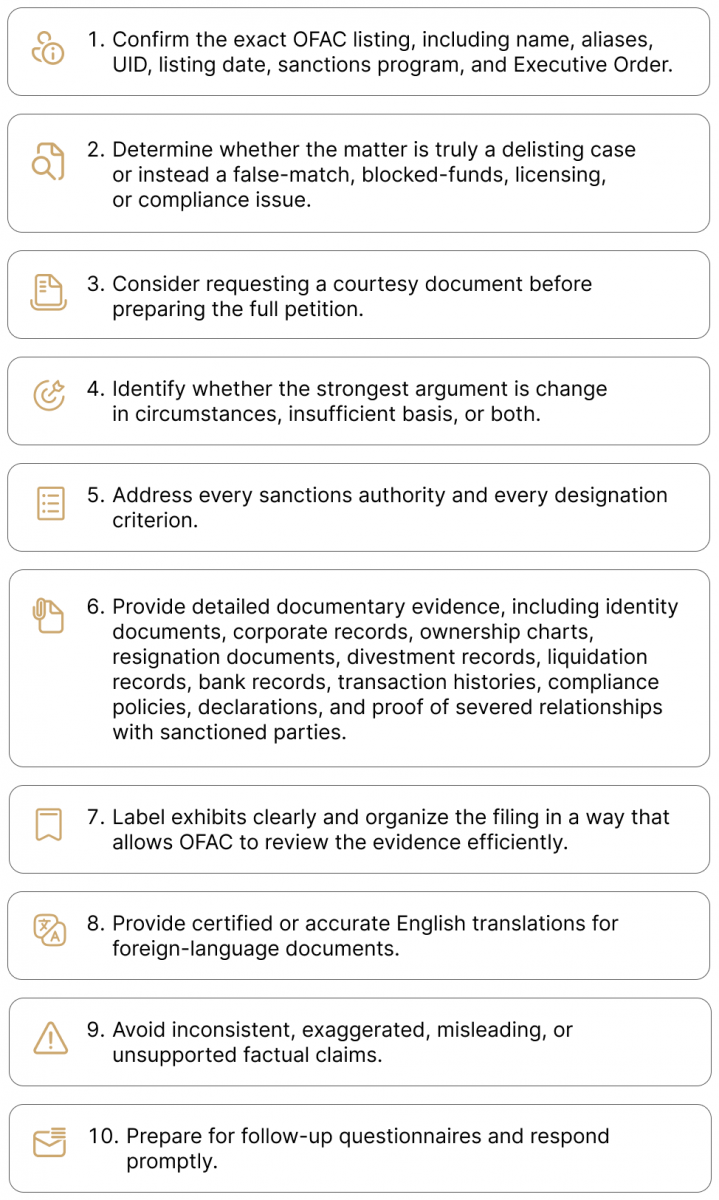
Best Practices for Preparing an OFAC Delisting Petition
An effective OFAC delisting petition should be organized, evidence-based, and directly tied to the applicable sanctions authority.
Best practices include:
False or Misleading Statements Can Create Serious Risk
OFAC delisting petitions must be accurate. Inconsistent, misleading, or false information may delay the case, damage credibility, or result in denial.
The risk is especially serious in SDN removal matters because petitions often involve sensitive facts about ownership, control, government relationships, business operations, banking activity, prior transactions, and contacts with sanctioned persons.
Knowingly and willfully submitting materially false, fictitious, or fraudulent statements to the U.S. government may also create criminal exposure. For this reason, every factual statement in an OFAC petition should be carefully verified before filing.
SDN Removal Is Not the Same as Unblocking Funds
SDN List removal and release of blocked funds are related but separate issues.
A delisting petition asks OFAC to remove a person, entity, or property from an OFAC sanctions list. A blocked-funds matter may require a separate OFAC license application or other request, particularly where a bank, brokerage firm, payment processor, or correspondent bank has frozen funds or rejected a transaction.
A complete sanctions strategy may involve several separate filings, including:
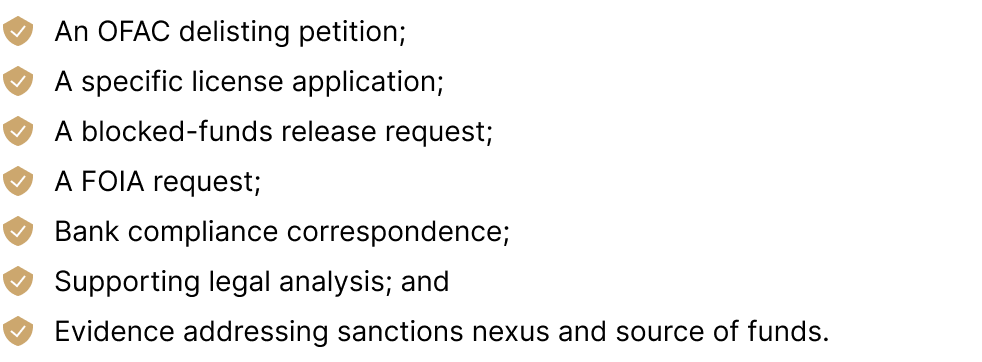
Combining unrelated requests in one filing may cause delay. Each OFAC request should be submitted through the proper channel.
Can a Denied OFAC Delisting Petition Be Refiled?
Yes. OFAC FAQ 1261 states that a petitioner may reapply after a delisting petition is denied. However, the renewed petition must present new arguments or new evidence. If the petitioner merely repeats the prior submission, OFAC may deny the new petition by reference to the previous determination.
This makes post-denial strategy important. A renewed petition should not simply repackage the same facts. It should identify what was missing, what has changed, what new evidence exists, and why OFAC should reach a different determination.
Practical Strategy for SDN List Removal
A strong SDN removal strategy usually begins before the petition is filed.
- Сounsel should identify the exact OFAC listing and determine the sanctions program, Executive Order, designation criteria, aliases, UID, and listing date.
- Counsel should determine whether the case involves actual sanctions listing, mistaken identity, blocked funds, rejected transactions, or licensing issues.
- Counsel should consider requesting a courtesy document to better understand the available basis for OFAC’s determination.
- Counsel should collect evidence addressing the designation criteria. This may include corporate documents, ownership records, bank records, employment records, resignation documents, liquidation records, compliance policies, transaction histories, government records, court documents, and sworn declarations.
- Counsel should prepare a legal and factual argument showing either that the circumstances have changed or that the designation lacked sufficient basis when imposed.
- Finally, the petition should be submitted in a clear, organized, and complete manner through the OFAC Reconsideration Portal.
FAQ: OFAC SDN List Removal
How do I ask OFAC to remove me from the SDN List?
A listed person, listed organization, owner of listed property, or authorized representative may submit a petition through OFAC’s administrative reconsideration process under 31 C.F.R. § 501.807. OFAC now strongly encourages use of the Reconsideration Portal.
Is the June 29, 2026 OFAC guidance a new regulation?
No. The underlying regulation remains 31 C.F.R. § 501.807. The June 29, 2026 update introduced the Reconsideration Portal and updated OFAC’s public guidance, FAQs, and quick-reference materials.
What are the main arguments for SDN removal?
The two main arguments are change in circumstances and insufficient basis. Change in circumstances means the facts supporting the designation no longer apply. Insufficient basis means there was no adequate basis for the designation when it was imposed.
How long does OFAC delisting take?
OFAC endeavors to conduct an initial completeness review within 7 to 10 business days, but full review may take much longer depending on the facts, evidence, petitioner responsiveness, and interagency consultation.
Can I reapply if OFAC denies my delisting petition?
Yes. A denied petitioner may reapply, but the new petition should include new arguments or new evidence. A repeated petition without new support may be denied by reference to the prior determination.
Should I submit an OFAC delisting petition by email?
OFAC now strongly encourages submission through the Reconsideration Portal and has stated that it is transitioning away from email submission in the future.
Is an OFAC delisting petition the same as a license application?
No. A delisting petition asks OFAC to remove a person, entity, or property from a sanctions list. A license application asks OFAC for authorization to engage in a transaction that would otherwise be prohibited or restricted.
Conclusion
OFAC’s June 29, 2026 update is an important procedural development for SDN List removal and other sanctions-list reconsideration requests. The new Reconsideration Portal is designed to make the process more structured and efficient, but it also increases the importance of submitting a complete, accurate, and well-supported petition from the beginning.
A successful OFAC delisting petition is not simply a hardship request. It is a legal and evidentiary submission that must show either that the facts supporting the sanctions designation have changed or that the designation lacked sufficient basis when imposed.
The strongest SDN removal petitions are accurate, well-documented, carefully organized, and directly tied to the applicable sanctions authority and designation criteria.