
 ES
ES  RU
RU  TR
TR  FA
FA  AR
AR  ZH
ZH Blog
Blog description

OFAC Specific License Taking Too Long? How to Request Expedited or Priority Review
When funds are blocked or a transaction cannot proceed because of U.S. economic sanctions, obtaining authorization from the U.S. Department of the Treasury’s Office of Foreign Assets Control (“OFAC”) can become critical. In many cases, however, filing the specific license application is only the beginning.
Applicants may wait months while a matter is reviewed. During that time, funds may remain blocked, contractual deadlines may approach, litigation may continue, businesses may experience significant financial consequences, and humanitarian or other urgent circumstances may develop.
This raises an important question:
Can an applicant ask OFAC to expedite a pending specific license application?
The short answer is yes, an applicant may present circumstances supporting urgent or priority consideration but there is no general right to expedited review, and OFAC does not guarantee that an application will be decided within a particular period.
The strength of the underlying application and the reasons for urgency are therefore critical.
What Is an OFAC Specific License?

Specific licenses are different from general licenses. A general license authorizes categories of transactions without requiring individual applicants to obtain separate permission, provided all conditions of the general license are satisfied.
When no applicable general license or exemption covers a prohibited transaction, an applicant may need to request a specific license.
OFAC considers specific license applications on a case-by-case basis. The agency also notes that applications may require consultation with other U.S. government agencies.
This is particularly relevant because the licensing process is not simply an administrative queue. OFAC may need to consider:
- the applicable sanctions regulations
- licensing policies
- parties to the transaction
- source and destination of funds
- financial institutions involved
- sanctions-policy implications, and
- input from other government agencies.
How Long Does an OFAC License Application Take?
There is no universal processing time.
OFAC expressly states that it cannot predict how long review of a particular license application will take. According to OFAC, each application is reviewed individually and often requires interagency consultation.
The complexity of the transaction can therefore have a substantial impact on timing.
For example, an application involving a single blocked payment with well-documented parties and a readily identifiable sanctions nexus may present different issues from an application involving multiple jurisdictions, several intermediary banks, sanctioned entities, disputed beneficial ownership, or complex commercial arrangements.
Importantly, OFAC states that following its existing application guidelines can help expedite a determination.
That makes the quality and completeness of the original submission particularly important.
Does OFAC Have an Expedited Review Process?
Applicants should be careful with the term “expedited.”
There is no generally applicable rule under which an applicant can simply pay an additional fee, select an “expedited processing” option, or require OFAC to decide an ordinary specific license application within a fixed number of days.
Nevertheless, circumstances may arise in which an applicant has legitimate grounds to request that OFAC give a matter priority consideration.
OFAC expressly recognizes priority treatment in at least certain contexts. For example, OFAC has stated that it prioritizes specific license applications and other requests for guidance related to humanitarian activity.
This demonstrates an important distinction:

What Circumstances May Support a Request for Expedited Consideration?
Whether a request is appropriate depends heavily on the facts. No particular circumstance guarantees accelerated treatment.
However, a stronger request will generally involve more than ordinary inconvenience associated with waiting for an agency decision.
Potential circumstances may include:
1. Humanitarian or Medical Necessity
Humanitarian circumstances can present particularly compelling grounds for priority consideration.
OFAC has expressly stated that it prioritizes licensing applications and guidance requests related to humanitarian activity.
Where delay affects access to medicine, medical equipment, humanitarian assistance, or other essential needs, the application should clearly identify the humanitarian consequences and provide supporting documentation.
2. Imminent and Irreversible Harm
An applicant may be able to demonstrate that continued delay will cause harm that cannot realistically be remedied later.
The important issue is not simply that the applicant wants the transaction completed quickly. The applicant should explain precisely what will happen if OFAC does not act before the relevant deadline.
3. Court or Regulatory Deadlines
A pending judicial proceeding, government-imposed deadline, settlement requirement, or other legally significant date may justify bringing the timing issue specifically to OFAC’s attention.
The relevant court order, settlement agreement, regulatory notice, or similar documentation should ordinarily accompany or support the request where appropriate.
4. Time-Sensitive Transactions
Certain transactions may become impossible after a specified date.
An applicant may therefore explain that a license issued after the relevant deadline would provide little or no practical relief.
However, commercial urgency alone should not automatically be assumed to justify expedited treatment.
5. Significant Consequences to Third Parties
In some situations, continued blocking may affect parties beyond the applicant—for example, employees, creditors, customers, financial institutions, or other innocent third parties.
Those consequences should be documented rather than described in general terms.
Commercial Urgency Alone May Not Be Enough
Applicants should distinguish between genuine urgency and ordinary commercial pressure.
The fact that money has been blocked for several months, a company wants access to its funds, or a transaction would be profitable does not necessarily establish circumstances warranting priority treatment.
Similarly, repeatedly contacting OFAC without providing new information or a substantive explanation for urgency may not accelerate review.
A stronger approach is to explain:
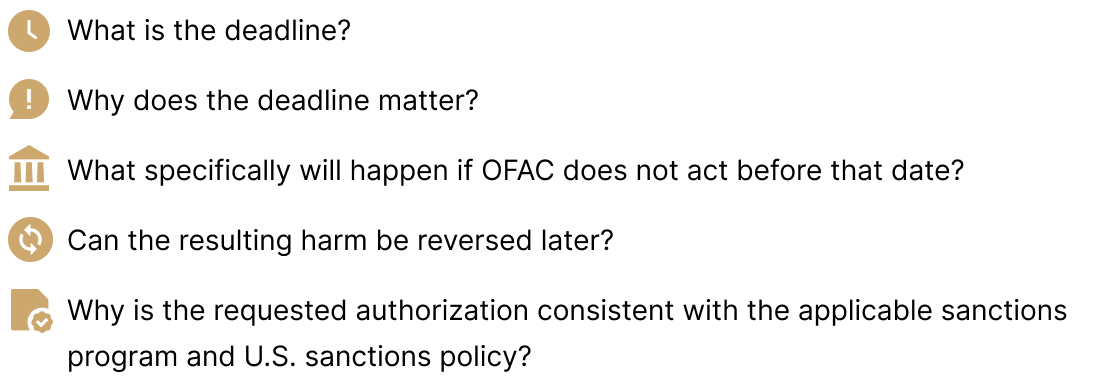
These questions help transform a general request to “please expedite” into a legally and factually supported submission.
The Underlying License Application Still Matters
An expedited request cannot cure a fundamentally deficient license application.
OFAC emphasizes the importance of providing detailed information about the proposed transaction and all relevant parties. In blocked-funds cases, OFAC specifically emphasizes describing the underlying transaction in detail and providing supporting documentation.
Before requesting priority treatment, applicants should therefore consider whether the underlying submission adequately addresses issues such as:
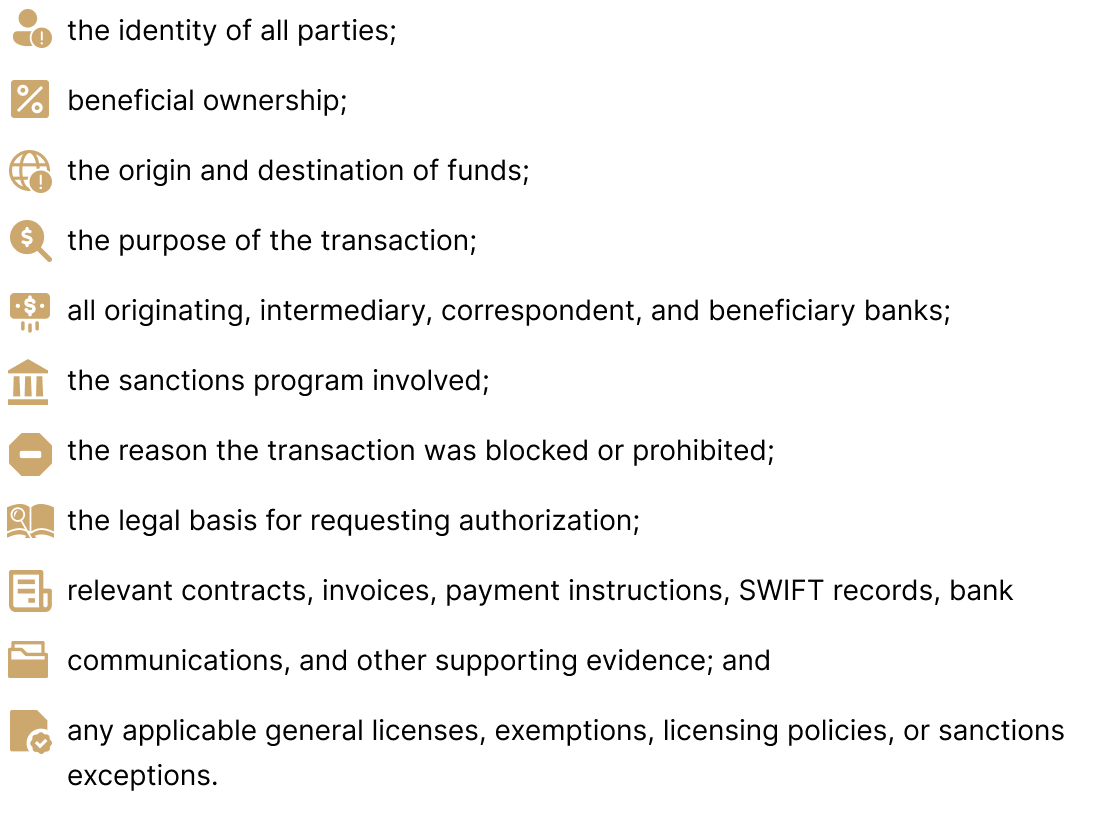
An incomplete application may generate additional questions and delay rather than accelerate the licensing process.
What If the Original Application Is Incomplete?
This can be an important issue in older pending cases.
Before focusing exclusively on expedition, an applicant should consider whether the original filing accurately presented the transaction and contained sufficient supporting evidence.
Depending on the circumstances, it may be appropriate to supplement the existing application with additional documentation, explanations, or legal analysis.
Material inconsistencies should be addressed carefully.
For example, differences among invoices, SWIFT messages, bank records, names of counterparties, payment descriptions, dates, amounts, or ownership information can raise questions that may need to be resolved before OFAC is prepared to authorize a transaction.
The objective should therefore not simply be to make OFAC review the application faster.
The objective should be to make the application as complete, coherent, and legally supportable as possible while separately explaining why time-sensitive consideration is warranted.
How Can Applicants Check the Status of an OFAC Application?
OFAC has substantially improved its licensing-status system.
Applicants can use their Case ID through OFAC’s Licensing Portal to check the progress of an application. OFAC currently uses several status categories, such as “In progress.”
Understanding the status can help determine what type of follow-up may be appropriate.
OFAC also operates a Licensing Hotline through an online platform for questions concerning specific licenses, interpretive guidance, the application process, and application status.
How Should a Request for Priority Consideration Be Presented?
There is no single formula appropriate for every case.
A well-supported request should generally be concise but specific. Depending on the circumstances, it may identify:
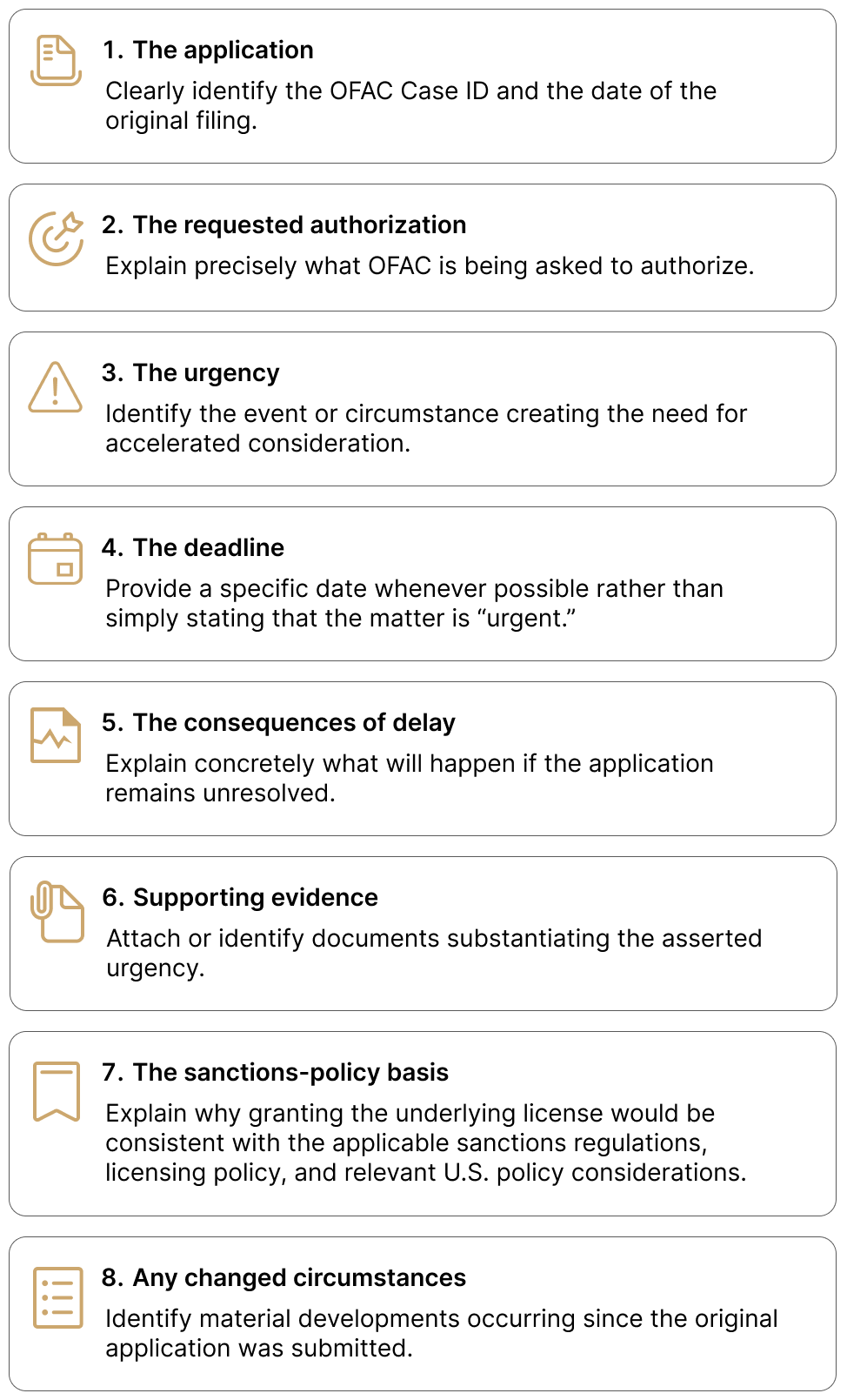
The submission should avoid overstating the facts. Unsupported assertions of emergency or irreparable harm can undermine credibility.
Can a Lawyer Expedite an OFAC Application?
An attorney cannot guarantee that OFAC will expedite or approve an application.
No lawyer can control OFAC’s internal review process, interagency consultation, or ultimate licensing determination.
Legal counsel can, however, evaluate whether there is a credible basis for requesting priority consideration and whether the underlying application is sufficiently developed to support a decision.
Counsel may also assist with identifying regulatory issues, correcting or explaining inconsistencies, preparing supplemental submissions, organizing supporting evidence, communicating with OFAC where appropriate, and presenting the legal and policy grounds for the requested authorization.
In complex sanctions matters, these issues can be particularly important because speed and substantive legal analysis are interconnected: an incomplete or poorly documented application may itself become a source of delay.
Blocked Funds and Requests for Expedited Review
Requests involving blocked wire transfers present recurring practical difficulties.
A transaction may involve parties who are not themselves sanctioned but nevertheless become blocked because of an intermediary bank, correspondent bank, sanctioned financial institution, ownership issue, geographic nexus, or another sanctions-related concern.
The applicant may then face a situation in which substantial funds remain immobilized while commercial obligations continue.
In such cases, the first question should be why the funds were legally blocked and what authorization is required to release them.
Only after understanding the sanctions nexus can an applicant properly evaluate the underlying specific-license strategy and whether there are credible grounds for requesting priority consideration.
Key Takeaway
It may be possible to ask OFAC to give a specific license application priority consideration, particularly where there are documented humanitarian or other genuinely time-sensitive circumstances.
But applicants should not confuse an expedited request with a guaranteed fast-track procedure.
OFAC reviews specific license applications case by case, processing time can vary considerably, and some matters require interagency consultation.
The strongest approach generally combines three elements:
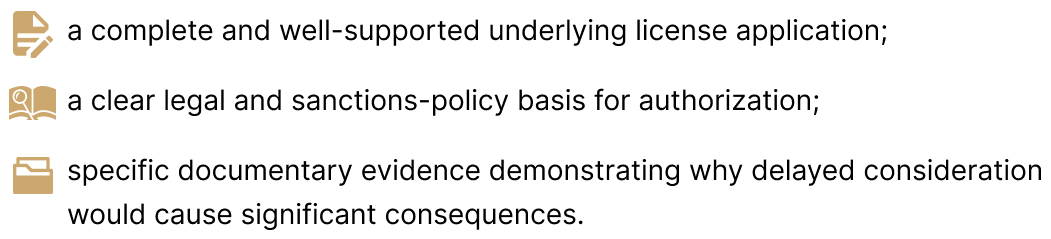
Where an OFAC specific license application has been pending for an extended period, or where new circumstances have made a decision particularly time-sensitive, applicants should consider reviewing both the substance of the original application and the grounds for requesting priority consideration before approaching OFAC.