
 ES
ES  RU
RU  TR
TR  FA
FA  AR
AR  ZH
ZH The SEC (Securities and Exchange Commission) enforces securities laws to prevent fraud in the stock market.
Securities and Exchange Commission (SEC) has specific criteria for a whistleblower case to qualify under its programs:
- Original Information: The information provided must be new and not already known to the SEC.
- Violation of Securities Laws: The reported misconduct must involve breaches of federal securities laws, such as insider trading, market manipulation, or misrepresentation of financial data.
- Significant Impact: The information must lead to a successful enforcement action resulting in sanctions exceeding $1 million.
The DOJ (Department of Justice) handles criminal cases related to financial crimes, including money laundering.
The Department of Justice (DOJ) evaluates whistleblower cases under programs like the False Claims Act (FCA) or anti-fraud statutes based on these criteria:
- Material Impact: The fraudulent act must involve significant harm to government funds, programs, or operations.
- Intent: The misconduct must be intentional, reckless, or knowingly deceptive.
- Jurisdiction: The reported violation must fall under U.S. federal law enforced by the DOJ.
- Evidence: Strong supporting evidence or documentation is crucial for the case to proceed.
The Foreign Corrupt Practices Act (FCPA) prohibits bribery of foreign officials by U.S. companies.
To qualify as a whistleblower case under the Foreign Corrupt Practices Act (FCPA), the following criteria generally apply:
- Bribery of Foreign Officials: The misconduct must involve bribery or corrupt payments to foreign officials to gain a business advantage.
- Jurisdiction: The company or individual must be subject to U.S. jurisdiction, such as a U.S.-based entity or foreign company listed on U.S. exchanges.
- Intent: The act must be knowingly and willfully committed.
- Accurate Records: Violations of accounting and record-keeping provisions (e.g., falsifying books) may also qualify.
AML (Anti-Money Laundering) laws are designed to prevent illicit financial transactions, requiring institutions to monitor and report suspicious activities. Together, these programs safeguard against financial crimes and ensure accountability in global markets.
To qualify under Anti-Money Laundering (AML) laws, cases must meet these key criteria:
- Involvement in Money Laundering Activities: The case must involve financial transactions designed to conceal or disguise the origins of illicit funds.
- Violation of Reporting Requirements: Non-compliance with mandatory reporting, such as suspicious activity reports (SARs) or currency transaction reports (CTRs), can qualify.
- Intentional Misconduct: The perpetrator must knowingly and willfully engage in activities to launder money.
- Connection to AML-Regulated Entities: Cases often involve banks, financial institutions, or businesses subject to AML regulations.
Reporting International Fraud
Reporting international fraud helps international whistleblowers protect the financial system and prevent illegal activities, and ensures integrity in global business and compliance with anti-corruption standards. To report Foreign Corruption or Money Laundering violations, it’s best to consult an experienced whistleblower law firm. They can guide you through the complexities of reporting and filing under whistleblower laws like the FCPA or AML regulations, ensuring confidentiality and protecting your rights as a whistleblower. Whistleblower lawyers can help you assess the case’s potential, prepare your claim, and ensure proper filing with agencies like the SEC, DOJ, or relevant authorities, increasing the chances of a successful outcome.

Please be advised that there are no obligations incurred until we have conducted a comprehensive review and reached a determination regarding the potential for proceeding with your matter.
Submit your case anonymously
What Is It?
Anti-Money Laundering (AML) refers to laws and regulations designed to prevent criminals from disguising illicit gains as legitimate income. These laws aim to detect and report suspicious financial transactions that could involve money laundering or terrorist financing.
Organizations Involved
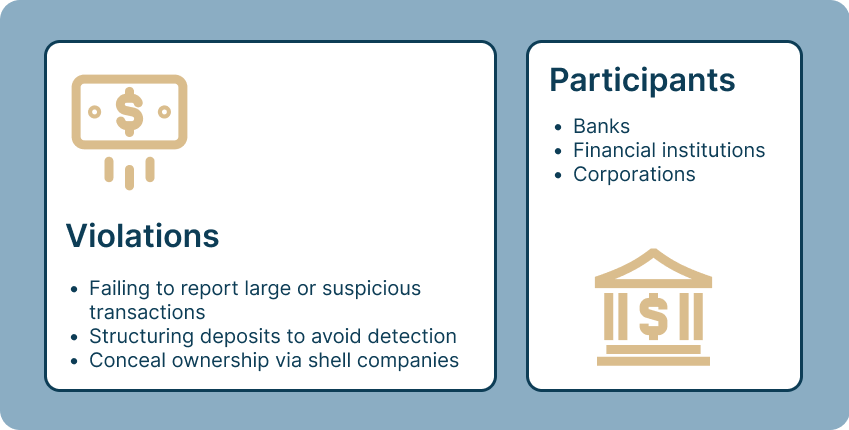
Banks, financial institutions, and corporations may be involved in money laundering schemes. For example, a bank may fail to report suspicious transactions or assist criminals in moving illicit funds across borders.
Reportable Activities
Key violations include:
- Failing to report large or suspicious transactions
- Structuring deposits to avoid detection
- Using shell companies to conceal ownership
Reporting international fraud helps international whistleblowers protect the financial system and prevent illegal activities, and ensures integrity in global business and compliance with anti-corruption standards. To report Foreign Corruption or Money Laundering violations, it’s best to consult an experienced whistleblower law firm. They can guide you through the complexities of reporting and filing under whistleblower laws like the FCPA or AML regulations, ensuring confidentiality and protecting your rights as a whistleblower. Whistleblower lawyers can help you assess the case’s potential, prepare your claim, and ensure proper filing with agencies like the SEC, DOJ, or relevant authorities, increasing the chances of a successful outcome.
Read about Government programs and laws governing International fraud here
Please be advised that there are no obligations incurred until we have conducted a comprehensive review and reached a determination regarding the potential for proceeding with your matter.
Submit your case anonymously
What Is It?
International fraud involves violations of laws across borders, including foreign corruption and money laundering. The Foreign Corrupt Practices Act (FCPA) targets bribery of foreign officials by U.S. companies, while anti-money laundering laws combat the concealment of illicit funds. Both types of fraud can lead to significant legal consequences, making it crucial to report violations through proper channels, often with legal assistance to ensure compliance and protection.
Foreign Corruption refers to the U.S. law prohibiting bribery of foreign government officials to secure business advantages, ensuring global ethical practices in international trade.

Organizations Involved
Companies in various industries, especially multinational corporations, and their employees may commit violations. For example, a U.S. company may offer bribes to foreign officials to win contracts or bypass regulations.
Reportable Activities
Key violations include:
- Bribing foreign officials for business favors
- Falsifying financial records to conceal bribes
- Offering kickbacks for procurement contracts
Reporting international fraud helps international whistleblowers protect the financial system and prevent illegal activities, and ensures integrity in global business and compliance with anti-corruption standards. To report Foreign Corruption or Money Laundering violations, it’s best to consult an experienced whistleblower law firm. They can guide you through the complexities of reporting and filing under whistleblower laws like the FCPA or AML regulations, ensuring confidentiality and protecting your rights as a whistleblower. Whistleblower lawyers can help you assess the case’s potential, prepare your claim, and ensure proper filing with agencies like the SEC, DOJ, or relevant authorities, increasing the chances of a successful outcome.
Read about Government programs and laws governing International fraud here
Please be advised that there are no obligations incurred until we have conducted a comprehensive review and reached a determination regarding the potential for proceeding with your matter.
Submit your case anonymously