
 EN
 ES
 RU
 TR
 FA
 ZH
Blog

New York RAISE Act: 2027 Requirements and Compliance Guide
New York’s RAISE Act establishes transparency, safety-framework, and incident-reporting requirements for covered frontier AI developers. The law takes effect January 1, 2027. Some obligations apply to frontier developers generally, while registration, public safety frameworks, and other additional duties apply to large frontier developers.
New York has already launched its RAISE Portal. Its Attorney General also announced a dedicated AI enforcement unit on November 17, 2026. Developers should now identify their category, assign compliance responsibilities, and prepare the relevant publications, filings, and incident procedures.
What Is New York’s RAISE Act?

Its focus is the development and operation of qualifying frontier models. Purchasing an ordinary AI application does not automatically place a business within the developer requirements.
The Office of Digital Innovation, Governance, Integrity and Trust, known as DIGIT, implements the Act within the New York State Department of Financial Services, or DFS.
Who Must Comply With the New York RAISE Act?
Coverage depends on the model, the developer’s activities, its connection to New York, and, for certain additional duties, group revenue.
|
Classification |
What to assess |
|
Frontier model |
A foundation model trained using more than 10²⁶ integer or floating-point operations |
|
Frontier developer |
A person training or initiating training of a qualifying frontier model using, or intending to use, the statutory computing power |
|
Large frontier developer |
A frontier developer whose annual gross revenue, together with affiliates, exceeded $500 million in the preceding calendar year |
The computing calculation includes original training and subsequent fine-tuning, reinforcement learning, or material modifications the developer applies.
The Act applies to frontier models developed, deployed, or operating wholly or partly in New York. Headquarters location alone does not determine coverage. Specific statutory exceptions include qualifying academic research by accredited New York colleges and universities.
Practical first step: Prepare a coverage memorandum recording:
- model classification,
- computing assumptions,
- affiliate revenue,
- New York connections, and
- applicable exceptions.
What Are the Main RAISE Act Requirements?
The distinction between frontier developers and large frontier developers determines which obligations apply.
|
Requirement |
Who is covered? |
Principal timing |
|
Basic model transparency report |
Frontier developers generally |
Before or concurrently with deploying a new or substantially modified frontier model |
|
Critical safety incident reporting |
Frontier developers generally |
Within the applicable 72-hour or 24-hour period |
|
Public frontier AI framework |
Large frontier developers |
Maintain an implemented framework; review at least annually |
|
Enhanced deployment disclosures |
Large frontier developers |
Before or concurrently with relevant deployment |
|
Disclosure statement and registration |
Large frontier developers operating in New York |
DFS directs registration by January 1, 2027 |
|
Internal-use catastrophic-risk assessment summaries |
Large frontier developers |
Recurring submissions; current DFS guidance specifies quarterly deadlines |
These requirements arise from different statutory provisions and should be tracked separately.
How Should Developers Prepare Their Safety Frameworks?
Responsible team: Model safety, engineering, security, legal, and designated management.
Deliverable: A published framework supported by operating procedures and records.
For large frontier developers, the framework must address subjects including catastrophic-risk assessments, mitigation measures, deployment decisions, third-party evaluation, model-weight security, incident response, and internal governance.

Material framework modifications and their justification must be published within 30 days. The law also addresses permitted redactions and requires retention of unredacted information for five years.
Assign an owner to each commitment and preserve evidence showing how assessments and mitigations informed decisions.
What Are the 72-Hour and 24-Hour Reporting Deadlines?
Responsible team: Incident response, model safety, security, and legal.
Deliverable: An escalation and reporting procedure with backup personnel.
A separate 24-hour disclosure requirement applies when the developer discovers that a critical safety incident poses an imminent risk of death or serious physical injury. Disclosure goes to an appropriate authority, such as a law-enforcement or public-safety agency with jurisdiction.
Staff should record:
- when relevant facts became known,
- who assessed the event, and
- when reporting decisions occurred.
DFS permits amended reports when additional information becomes available.
How Does RAISE Act Registration Work?
Responsible team: Legal, corporate governance, finance, and authorized portal users.
Deliverable: A current disclosure statement and reporting calendar.
Large frontier developers must establish portal access, confirm authorization to act for the developer, and submit the required disclosure information. DFS directs covered large developers to register by January 1, 2027.

Disclosure statements require renewal every two years, upon model-ownership transfer, or after a material change to reported information, whichever occurs earlier. Assessment payments also require attention.
For internal-use catastrophic-risk summaries, current DFS guidance specifies filing within 30 days after calendar-quarter end. The statute permits another reasonable written schedule agreed with the office. Confirm the applicable reporting period and any approved alternative.
What Are the Penalties for RAISE Act Violations?

These include required-document failures, certain misleading statements, incident-reporting failures, and failure to comply with the developer’s own framework.
Separate disclosure provisions authorize a $1,000 daily penalty for specified filing or false-information failures, after notice and hearing. These are distinct enforcement provisions.
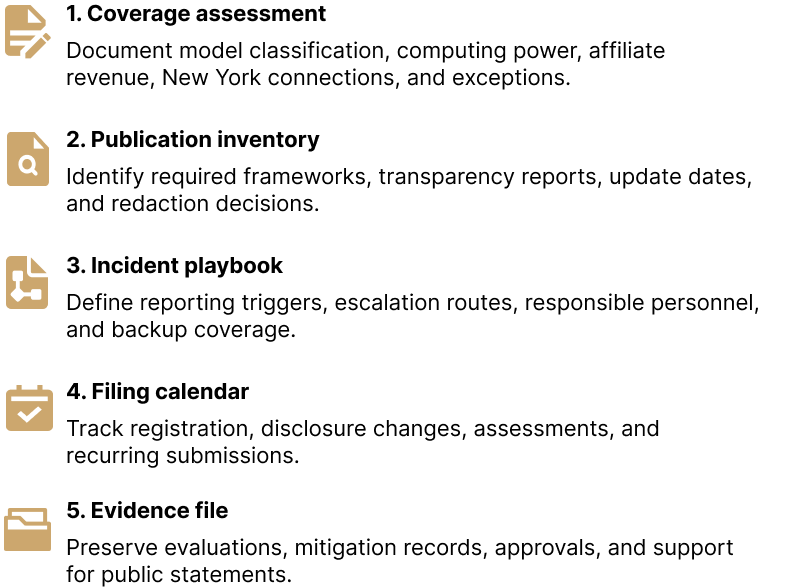
RAISE Act Compliance Checklist Before January 2027
Covered developers can organize readiness around five concrete deliverables:
A simulated incident can test whether personnel recognize a potential reporting trigger and reach authorized decision-makers promptly.
Frequently Asked Questions About New York’s RAISE Act
When does the New York RAISE Act take effect?
The Act takes effect January 1, 2027. DFS directs large frontier developers operating in New York to complete registration by that date. Requirements depend on the developer’s category and the model’s New York connection.
Does the RAISE Act apply to every business using AI?
No. Purchasing or using third-party AI does not automatically make a business a frontier developer. Training, fine-tuning, and material model modifications require closer assessment. Other legal obligations may still apply.
Does the Act regulate only large frontier developers?
No. Frontier developers generally have transparency and critical safety incident reporting duties. Large frontier developers have additional obligations, including public frameworks, registration, enhanced disclosures, and recurring assessment summaries.
Can a company outside New York be covered?
An out-of-state headquarters does not automatically exclude a company. The statutory inquiry concerns frontier models developed, deployed, or operating wholly or partly in New York. The relevant activities and connections require assessment.
Must every AI error be reported?
No. “Critical safety incident” has specific statutory conditions. An inaccurate answer, malfunction, or complaint does not automatically qualify. The company should assess the facts against the definition and document its conclusion.
Can reporting wait until an investigation is complete?
The 72-hour trigger includes learning facts sufficient to establish a reasonable belief that a critical safety incident occurred. A company should assess that trigger while investigating, rather than assume reporting can always wait for final confirmation.
Can private parties sue directly under the RAISE Act?
The Act creates no private right of action for its violations. It preserves other legal duties and remedies, so separate claims or enforcement authorities may require consideration.
Conclusion
RAISE Act compliance begins with identifying the correct developer category and translating the applicable requirements into operating procedures.
Before January 1, 2027, covered developers should assign responsibility for publications, registration, incident escalation, and recurring filings. The resulting records should explain how public commitments connect to actual assessments, mitigations, and decisions.
Continued review of DFS guidance and legislative developments can help keep that compliance process aligned with the applicable requirements.