
 EN
 ES
 RU
 TR
 FA
 AR
Blog

Bank Account Freezes and AML Holds: How to Identify the Restriction and Seek Release
A bank account restriction can interrupt payroll, delay a business acquisition, prevent a real estate closing, or leave an individual unable to access savings. The customer may receive only a short explanation: the account is under review, additional information is required, or the bank’s compliance department must authorize further activity.
The next step depends on understanding what the restriction actually involves. An identity-verification issue, an anti-money laundering review, a deposit hold, and a government restraint can produce similar practical consequences while requiring different responses.
The Bank Secrecy Act (BSA), anti-money laundering (AML) controls, and suspicious activity reports (SARs) are central to this analysis. They establish compliance and reporting responsibilities, but those responsibilities must be distinguished from the particular authority supporting a restriction on funds.
Explore our AML & Financial Counsel Services and OFAC Sanctions Compliance Services
What Does “Frozen” Mean?
Customers often use “frozen” to describe several different situations:
- A particular incoming payment is awaiting review.
- Funds from a deposited check are temporarily unavailable.
- Outgoing transfers are restricted.
- Certain account functions remain available while others are disabled.
- The entire account is restricted.
- The bank has announced an intention to close the relationship.
- Funds are subject to sanctions or legal process.
These distinctions determine what relief should be requested. Releasing one payment differs from restoring full account access. Completing identity verification differs from resolving questions about a counterparty or transaction.
A useful initial inquiry identifies the affected account, amount, payment reference, restriction date, and permitted activity. Where available, written clarification can help prevent misunderstandings about the scope of the review.
The BSA and AML Framework

For federally regulated banks, 31 C.F.R. § 1020.210(a)(2)(v) requires risk-based procedures for understanding customer relationships, monitoring activity, and maintaining appropriate customer information.
This framework helps explain why a bank may ask questions when activity changes. A business that previously received domestic customer payments may begin receiving substantial international transfers. An individual may receive proceeds from an inheritance or asset sale. A company may receive payment from an affiliate rather than the party named in its contract.
Those circumstances may have legitimate explanations. The practical task is to connect the transaction to reliable evidence and address the specific information gap.
A reference to “BSA compliance” alone does not establish how long a particular restriction may continue. The account agreement, applicable regulations, actual concerns, and any separate legal process require examination.
Identity Verification and Beneficial Ownership
Three inquiries should be separated.
Identity verification concerns who the customer is. Under 31 C.F.R. § 1020.220(a)(2)(iii), banks must maintain procedures addressing situations where they cannot form a reasonable belief that they know a customer’s true identity. Those procedures address permitted account use during verification and closure after unsuccessful verification efforts.
Beneficial ownership review concerns the individuals who own or control a covered legal entity. Section 1010.230 generally addresses qualifying equity owners and a person with significant management responsibility, subject to exclusions and exemptions.
Transaction review concerns where particular funds originated, why they moved, and how the parties are connected.
Documents addressing one inquiry may leave another unresolved. A company’s formation certificate may establish its existence without fully explaining its ownership. Identification documents may establish the account holder’s identity without explaining a third-party payment.
FinCEN’s February 13, 2026 exceptional relief is also relevant. It allows covered institutions to limit beneficial-owner identification and verification to the first account opening, circumstances calling earlier information into question, and needs arising from ongoing risk-based due diligence. It does not eliminate ongoing customer due diligence.
Understanding SARs
A SAR is a report concerning activity meeting applicable suspicious activity reporting criteria. It is not a judicial finding that a crime occurred.

Reporting and restricting access are separate questions. A bank’s obligation to report activity does not, by itself, establish the legal basis for every restriction imposed during its review.
The BSA also does not automatically require account closure after one SAR or any number of SARs. Decisions about maintaining the relationship involve the institution’s assessment of available information, risk, and applicable policies.
What Banks May Explain
SAR confidentiality protects the report and information revealing its existence. Customers should therefore focus requests on information that can help resolve the underlying concern.
Section 1020.320(e) distinguishes protected SAR information from underlying facts, transactions, and documents. Federal regulators’ September 2026 joint statement confirms that banks may discuss transaction information and request explanations without revealing a SAR.
Useful requests include identifying the payment requiring clarification, the documents still needed, and the department responsible for review. Other confidentiality obligations may also limit disclosure.
Permissible communications do not create a universal duty to provide a complete explanation. Nevertheless, a targeted request can help establish what the customer can do to advance the process.
Reporting Deadlines and Release Deadlines Are Different
Section 1020.320(b)(3) generally establishes a 30-calendar-day SAR filing period after detection of facts supporting a report. A limited additional period applies when no suspect is initially identified.
These reporting deadlines do not establish a standard freeze period. They provide neither blanket authority to restrict funds for 30 days nor a guarantee of release on day 30.
Any release timetable must be evaluated against the actual restriction, applicable account terms, deposit rules, sanctions, and legal process. Customers should also distinguish an internal processing estimate from an enforceable deadline.
Deposit Holds and Regulation CC
Where Regulation CC applies, 12 C.F.R. §§ 229.10 and 229.12 establish availability requirements, while § 229.13 provides exceptions.
For example, a reasonable-cause exception for doubts about check collectibility requires supporting facts. Applicable exception notices and extensions must satisfy the regulation’s requirements.
Counsel should examine:
- the deposit,
- account,
- claimed exception,
- notice, and
- duration.
Describing a restriction as an AML review does not resolve whether applicable funds-availability obligations have been satisfied.
Information Requests and Legal Restraints
A bank may receive requests connected to a government investigation. Section 314(a), implemented through 31 C.F.R. § 1010.520, establishes information-search and reporting procedures.
Section 1010.520(b)(3)(v) expressly states that the rule does not itself require action concerning an account or transaction merely because a subject appears in a request. The request is separately subject to confidentiality protections.
An information request should therefore be distinguished from a seizure warrant or judicial restraint. Where the actual legal process restricts funds, the response must address that process and its applicable deadlines.
Building a Useful Release Submission
A strong submission explains the transaction and connects each important assertion to supporting records.
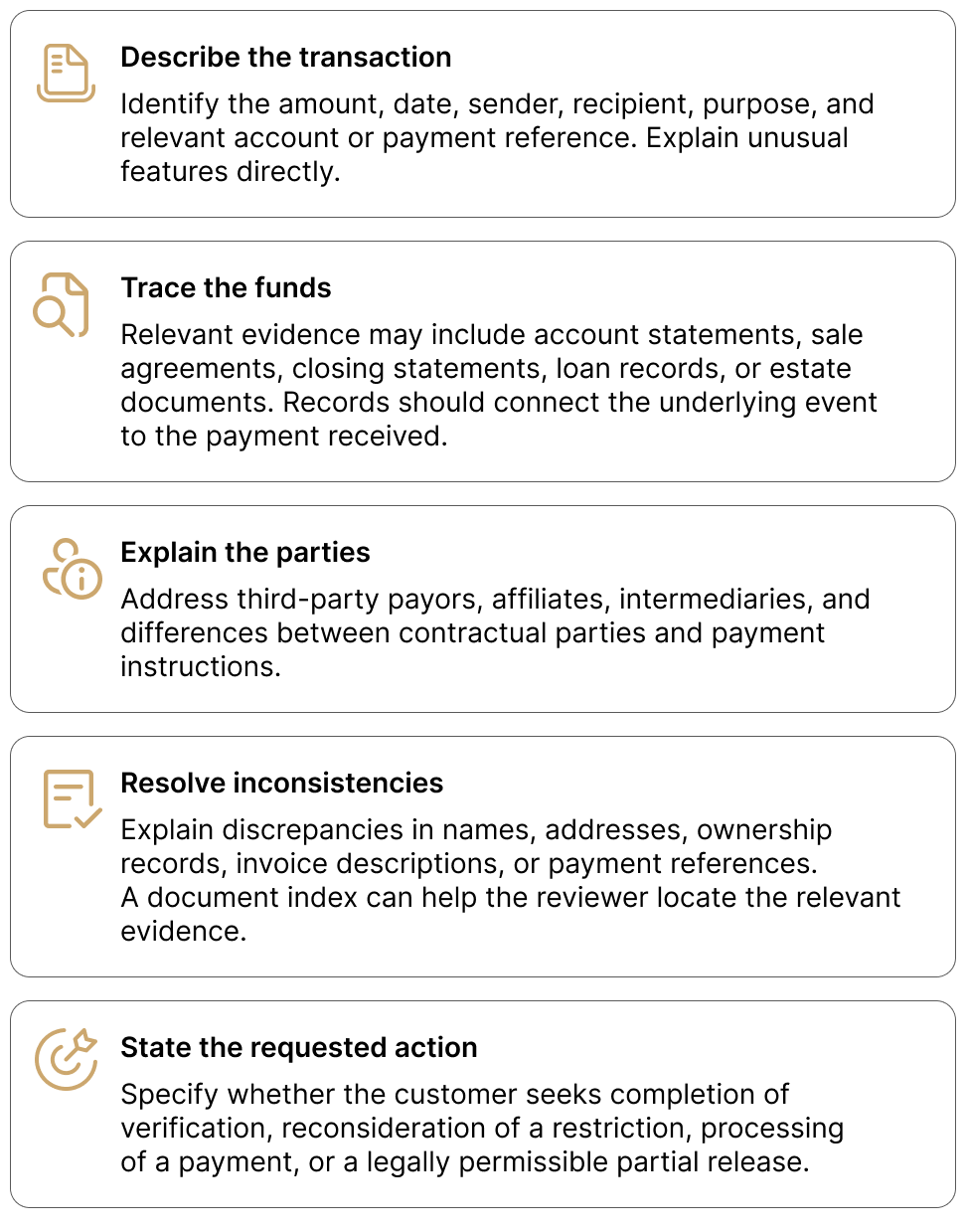
Consider a hypothetical inheritance payment. A receiving-account statement may show that funds arrived, while estate and distribution records explain the payment’s origin and purpose. For a business payment made by an affiliate, the contract and payment instructions may need an accompanying explanation of the affiliate’s role.
These are practical examples, not documents every bank must obtain or a guarantee of release.
Escalation and Continuing Restrictions
A written escalation should
- identify the restriction,
- summarize materials already supplied,
- list unanswered questions, and
- state the requested action.
Where timing is critical, document affected payroll, contractual commitments, or closing dates. Financial urgency can support a focused request, but it does not automatically override a restraint.
Maintain a submission log and preserve notices and correspondence. Counsel should assess the appropriate bank escalation, regulatory complaint, contractual procedure, or judicial response.
Separate restrictions should remain separately tracked. Resolving identity verification may leave a transaction concern outstanding. Completing an AML review may leave another legal restriction in place.
Frequently Asked Questions
Does an account restriction mean that money laundering has been established?
No. A restriction alone establishes neither a criminal charge nor a finding of wrongdoing. Its actual basis must be identified.
Why does the bank need documents for a legitimate payment?
The bank may need to understand how the payment fits the customer relationship or resolve inconsistencies in its records. An explanation supported by documents can address questions that the payment record alone does not answer.
Must the bank disclose whether it filed a SAR?
The bank cannot disclose a SAR or reveal its existence. Requests should focus on underlying transactions, missing information, and the review process.
Does every cash transaction report indicate suspicion?
No. Currency transaction reporting under 31 C.F.R. §§ 1010.311 and 1010.313 differs from suspicious activity reporting. The reporting obligation should not be treated as a finding of unlawful conduct.
Must funds be released after 30 or 60 days?
The SAR reporting periods do not establish a universal release deadline. The applicable restriction and governing requirements must be examined separately.
Can a customer request partial access for payroll or living expenses?
Yes, a customer can document the need and request consideration of a legally permissible release. Whether release is available depends on the governing restriction.
What if the bank intends to close the account?
Clarify the closure timetable and the status of the funds separately. Request available information about outstanding verification requirements, disputed amounts, and the proposed disposition of unrestricted funds.
Does an available balance guarantee that money can be withdrawn?
A displayed balance should not be treated as resolving a separate account restriction. Confirm the activity the bank currently permits.
Conclusion
Effective responses to account restrictions begin with identifying the actual issue. BSA requirements, AML monitoring, SAR reporting, deposit rules, and legal process can overlap while presenting different questions about authority and release.
A coherent factual record helps address those questions. Identity and ownership documents establish who is involved; transaction records explain where funds originated and why they moved. A targeted submission then connects that evidence to the requested action.
Throughout the process, customers and counsel should track outstanding requirements, preserve communications, and distinguish the bank’s review timetable from applicable legal deadlines.